
|
◷ THE 30-SECOND VERSION • Start with bag style and width × gusset depth × height; nominal size names are only shortcuts. • Use basis weight or grammage to compare paper mass, not finished-bag carrying capacity. • Check construction, moisture exposure and direct-food-contact suitability. • Approve a bag through a documented test using representative contents and handling conditions. |
FIRST IDENTIFY THE BAG STYLE
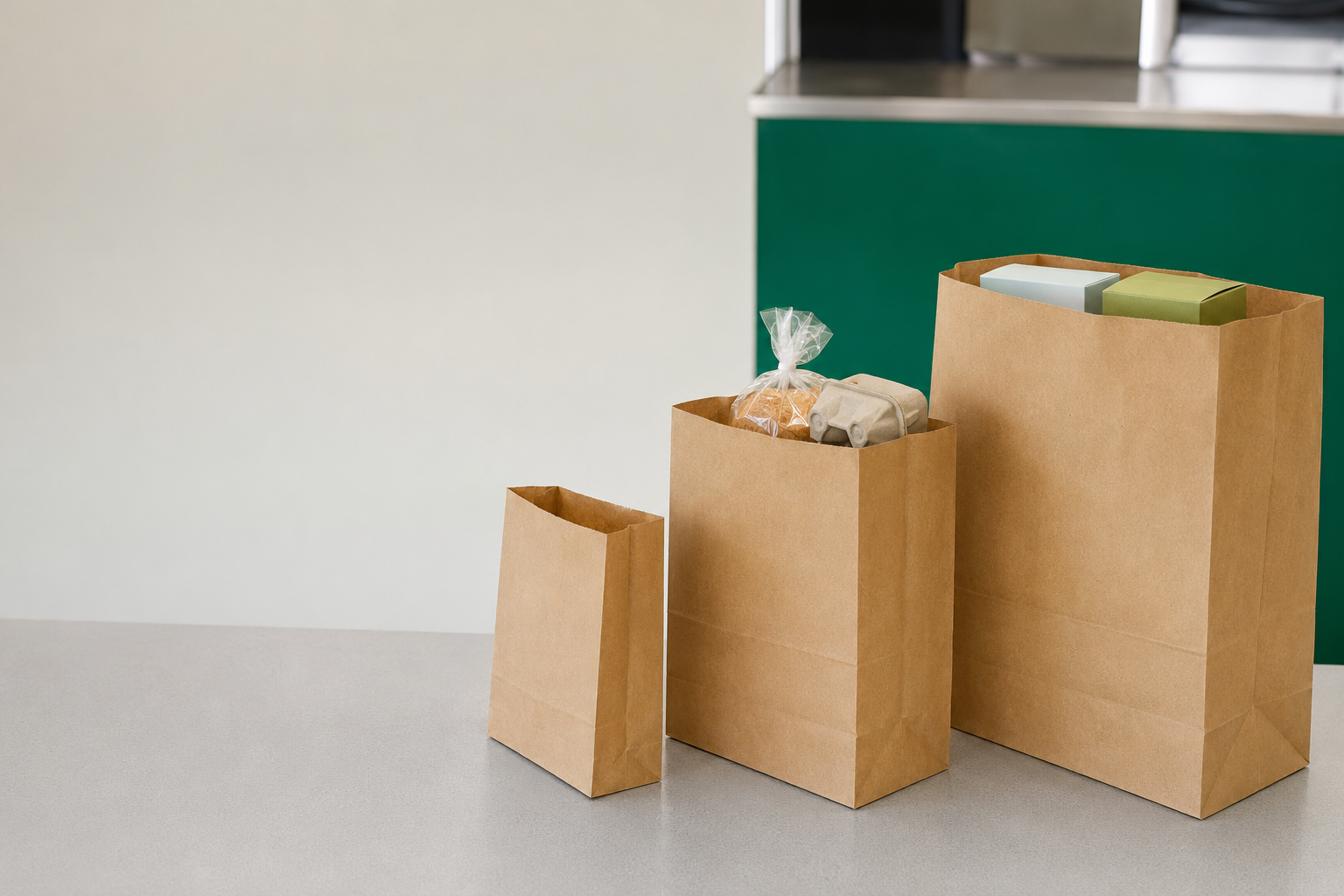
Start with bag style. SOS (Self Opening Style) bags have block bottoms and side gussets. Larger grocery sacks may use fractional-barrel names, while shopping bags commonly add handles or top reinforcement. Similar dimensions do not guarantee similar packing or carrying performance.
|
STYLE OR LABEL |
WHAT IT DESCRIBES |
HOW TO USE IT |
|
SOS bag |
Flat-bottom bag with side gussets |
Compare dimensions and paper construction |
|
Fractional-barrel sack |
Common grocery-sack size family |
Use as a format name, then verify dimensions |
|
Nominal pound size |
Traditional size designation used for many SOS bags |
Do not interpret the number as a safe load |
|
Handled shopper |
Carryout bag with handles |
Check attachment and reinforcement |
Terms such as 1/6 BBL, 1/7 BBL, 1/8 BBL and nominal 2 lb through 25 lb sizes are widely used, but exact dimensions and constructions are not guaranteed to be identical across manufacturers. Treat the style name as a starting point for comparison—not as the final specification.
READ DIMENSIONS AS WIDTH × GUSSET × HEIGHT
Paper bags are generally listed as width × gusset depth × height. Width is the front panel, the folded gusset expands to create depth and height runs from bottom to open top. Confirm the supplier’s stated order because other packaging categories may present dimensions differently.
Width and opened gusset determine the bottom footprint. It should accommodate the widest routine container without forcing corners into folds. Height provides stacking and closure space, but excess height can encourage overpacking. Usable interior space may be slightly less than the listed outside dimensions.
|
💡 QUICK TIP Measure the actual container at its widest points, including lids, flanges and handles. Allow working clearance for loading instead of choosing a bag whose listed dimensions merely equal the container. |
SEPARATE PAPER METRICS FROM LOAD PERFORMANCE
Basis weight is the mass, in pounds, of a specified ream. Ream size and sheet count are part of the definition, so equal pound values are not necessarily equivalent unless they use the same basis convention. Grammage, expressed in grams per square meter (g/m² or gsm), is easier to compare across paper categories.
Higher basis weight or grammage generally means more fiber per unit area, but it does not establish finished-bag strength. Fiber furnish, orientation, moisture, adhesives and converting quality also matter. Caliper measures thickness, not mass or strength; papers with similar caliper can have different density and mechanical properties.
|
METRIC |
WHAT IT MEASURES |
WHAT IT DOES NOT PROVE |
|
Basis weight |
Ream mass under a stated paper convention |
Finished-bag load capacity |
|
Grammage (gsm) |
Paper mass per square meter |
Seam, bottom or handle strength |
|
Caliper |
Paper thickness |
Tear resistance or wet performance |
|
Tensile and tear data |
Resistance under a defined laboratory method |
Performance of every converted bag in every use |
CONSTRUCTION DETERMINES HOW THE PAPER PERFORMS
The converted bag is a system. Side seams and bottom seals transfer force, while fold geometry affects how the base supports contents. On handled bags, the handle, attachment area and reinforcement determine where carrying force enters the structure. Dimensions and paper weight alone leave important variables unknown.
Read fiber and environmental claims precisely. Virgin and recycled papers can each be engineered for different performance levels; recycled content alone does not predict strength. Certifications may address sourcing or compostability but do not replace testing. For direct contact with unpackaged food, request documentation covering the intended food, temperature and conditions of use.
WHY THERE IS NO UNIVERSAL BAG LOAD FORMULA
Basis weight cannot be converted into a dependable finished-bag capacity. Load distribution, container shape, sharp edges, moisture, temperature, carrying method and duration all change stress. A stable load supported from below behaves differently from shifting bottles, a condensing hot container or a bag lifted from one handle.
Use a manufacturer load claim only when its test method, bag construction and conditions are identified. Otherwise, treat the claim as screening information and conduct an application test. The approved working load should include a reasonable margin below the point where deformation or failure begins.
SIX-STEP APPROVAL TEST
01 Define: Record the contents, temperature, maximum routine weight and expected carry method.
02 Measure: Compare the widest container with the bag’s usable width and opened gusset.
03 Confirm: Review paper metrics, construction, handles and any required food-contact documentation.
04 Pack: Load representative orders, including the heaviest normal combination and awkward shapes.
05 Condition: Include the normal staging time, heat, humidity and condensation exposure.
06 Carry: Use the expected distance and inspect the bottom, seams, gussets, top and handles afterward.
|
⚠ COMMON MISTAKE PROBLEM Selecting a bag from its nominal size or basis-weight number alone. ↓ WHY IT HAPPENS Traditional size labels and paper-weight values look like capacity ratings, even though they describe format or paper mass. ↓ BETTER APPROACH Compare the full specification, then establish an approved pack-out through documented application testing. |
BUILD A COMPLETE COMPARISON SHEET
For each candidate, record style, nominal size, dimensions, basis weight and basis convention or gsm, caliper, fiber composition, seams, bottom and handle construction, coatings, certifications, case quantity and tolerances. Include documented performance claims and their test conditions.
After approval, connect each bag to a defined order family and packing method. Monitor tearing, soft bottoms, handle separation, double-bagging and excess empty space. Those observations reveal whether the selected specification matches the operation more reliably than the catalog name alone.
CONCLUSION: READ THE WHOLE SPECIFICATION
Bag style and dimensions explain fit. Basis weight, grammage and caliper describe the paper. Construction details explain how the finished bag is assembled. None of these values alone establishes a safe working load.
A sound purchasing decision combines comparable specifications, appropriate food-contact documentation and a repeatable test using the contents and conditions the bag will actually encounter.
|
✓ KEY TAKEAWAY Use industry metrics to compare candidates, then approve the complete bag—not one number—under realistic operating conditions. |
Explore Food-Grade Bags
Share:
How to Choose the Right Corrugated Box for Your Product
Five Causes of Takeout Bag Failure—and How to Prevent Them