
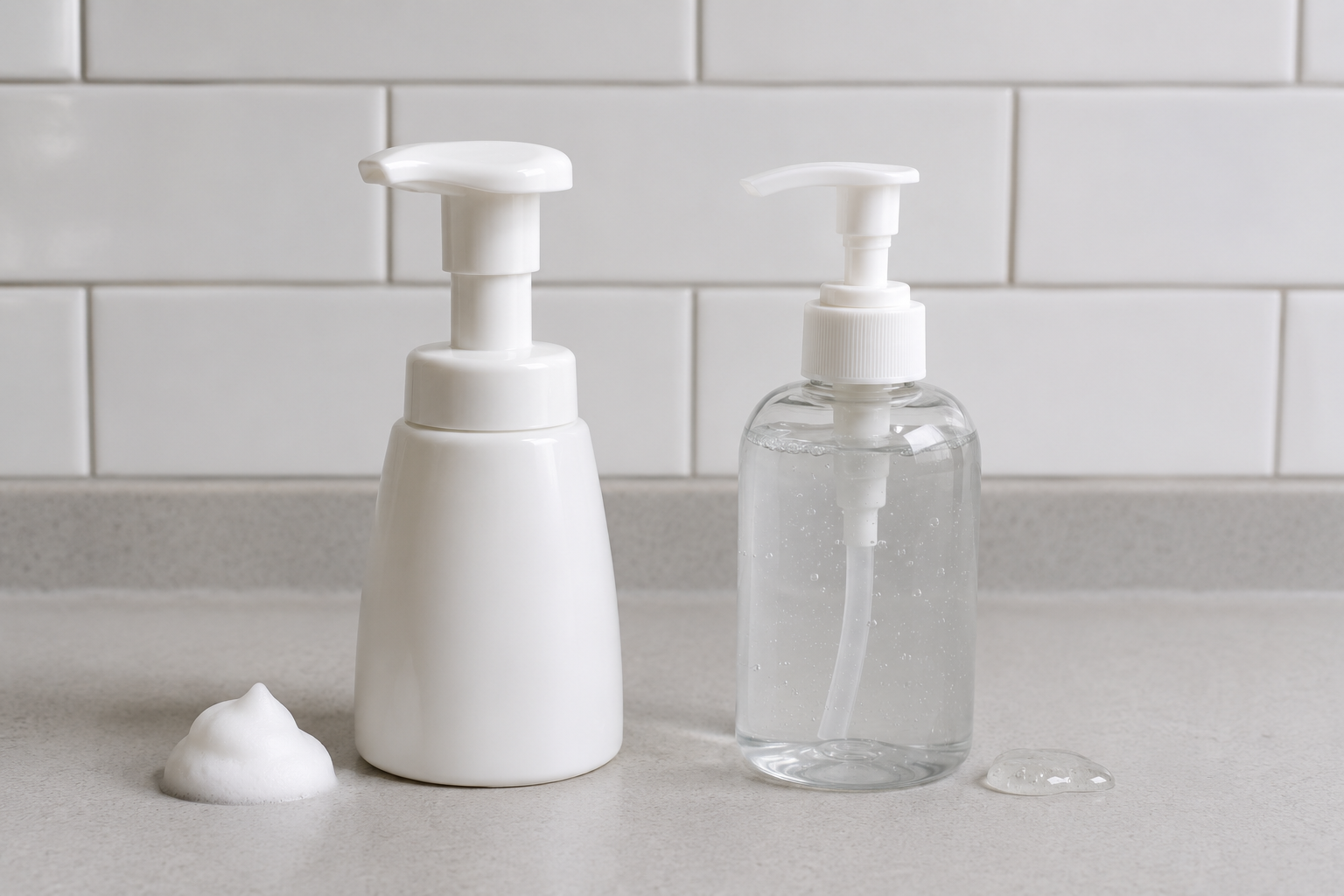
|
THE 30-SECOND VERSION 1. Foam arrives at the hand already aerated, creating quick coverage with a controlled dose. 2. Liquid offers a dense, familiar feel and may be preferred where hands encounter grease or heavier soil. 3. Compare cost per handwash and service labor—not refill price alone. 4. Never place foam product in a liquid dispenser, or liquid product in a foam dispenser, unless the manufacturer explicitly approves it. 5. Standardizing one compatible system across a facility usually simplifies purchasing and maintenance. |
THE PRACTICAL DIFFERENCE
Both formats use surfactants to loosen soil and oils so they can be rinsed away. The main operational difference is how the product is delivered. A foam dispenser mixes soap with air at the pump, while a liquid dispenser delivers a denser product directly. That distinction affects dose size, how quickly soap spreads, the feel of the wash and the dispenser components required.
For most offices, schools and public restrooms, either format can work well when people use enough product, scrub thoroughly and rinse. Facility managers should therefore judge the complete handwashing system: formulation, dispenser, refill capacity, placement, maintenance and user behavior.
SIDE-BY-SIDE COMPARISON
|
Decision factor |
Foam soap |
Liquid soap |
|
User experience |
Light, quick to spread and easy to see across the hands. |
Dense, familiar lather with a more substantial feel. |
|
Typical dose |
Often dispensed in a smaller controlled volume. |
Often uses a larger volume per activation, depending on the pump. |
|
Best fit |
High-traffic restrooms, schools, offices and facilities prioritizing controlled use. |
Industrial sinks, service areas and locations where users prefer a richer wash. |
|
Maintenance |
Requires a foam-specific pump and correct-viscosity refill. |
Requires liquid-compatible valves, pumps and refill connections. |
|
Cost lens |
Can reduce product used per wash, but system-specific pricing matters. |
Refills may appear economical; verify actual dose and consumption. |
|
Potential drawback |
May feel less substantial to some users or struggle if an incompatible refill is installed. |
Can drip or leave residue when dose, viscosity or dispenser condition is poorly matched. |
WHEN FOAM SOAP IS USUALLY THE BETTER FIT
Foam is often a strong choice when a facility has many users, predictable restroom traffic and a need to control consumption. Because the dose is aerated before it reaches the hand, users get visible coverage quickly. A controlled-dose dispenser can also make ordering more predictable and reduce the temptation to press the dispenser repeatedly.
1. High-traffic public restrooms. Fast spreading and consistent dosing support efficient use during busy periods.
2. Schools and office buildings. A light, easy-rinsing product can create a straightforward everyday experience.
3. Facilities standardizing dispensers. One foam platform and refill family can simplify stockrooms and service routes.
4. Water- and waste-conscious programs. Some foam systems use a smaller product dose; confirm the manufacturer’s documented output before estimating savings.
|
● QUICK TIP Calculate cost per 1,000 handwashes: refill cost ÷ expected doses × 1,000. Then add dispenser, battery and labor costs for a fair system comparison. |
WHEN LIQUID SOAP IS USUALLY THE BETTER FIT
Liquid can be the better choice where users routinely encounter visible dirt, oils or shop residue and expect a more substantial product. The formulation—not merely the liquid format—determines cleaning performance, so industrial environments should look for a cleaner designed for the soil being removed. A general restroom soap should not be treated as a heavy-duty hand cleaner.
Liquid may also make sense when the facility already owns a reliable, standardized liquid dispensing system. Replacing working dispensers to chase a small refill-price difference can erase projected savings. Compare the remaining life of existing hardware, conversion labor and the risk of holding two refill families during the transition.
USE TOTAL COST, NOT PACKAGE PRICE
A lower-priced gallon or refill is not automatically less expensive in use. Dose size, wasted product, incomplete refills, emergency purchases and staff time all change the real cost. Track consumption for four to six representative weeks before making a large conversion, avoiding holiday shutdowns or unusual occupancy periods.
|
Measure |
What to record |
Why it matters |
|
Product use |
Refills consumed by location and week |
Shows actual demand rather than theoretical yield |
|
Service time |
Minutes to inspect, refill and clean each unit |
Reveals labor differences between systems |
|
Waste |
Leaking units, discarded partial refills and spills |
Identifies preventable product loss |
|
User response |
Complaints, repeat activations and empty units |
Shows whether the selected dose works in practice |
A SIMPLE SELECTION FRAMEWORK
1. Start with the soil. Choose an everyday hand soap for normal restroom use and an appropriate heavy-duty cleaner for oils, grease or industrial residue.
2. Audit current dispensers. Record brand, platform, format, capacity, manual or automatic operation and compatible refill numbers.
3. Estimate real consumption. Use dose data and observed refill use rather than relying on container size.
4. Consider the service route. Favor systems that staff can identify, refill and troubleshoot without guesswork.
5. Pilot before converting. Test representative high-, medium- and low-traffic locations before changing the entire facility.
|
✓ KEY TAKEAWAY Foam is often strongest for controlled dosing and high-traffic everyday use. Liquid can be a better fit for a substantial wash experience, specialized soils or an established liquid system. The winning choice is the compatible system that users accept and staff can maintain reliably. |
CHOOSE THE SYSTEM YOUR FACILITY CAN SUSTAIN
There is no universal winner between foam and liquid soap. A busy school may value foam’s controlled dose, while a production area may need a purpose-built liquid hand cleaner. An office with dependable liquid dispensers may gain little from converting at all.
Make the decision at the system level. Match the formula to the soil, the refill to the dispenser, capacity to traffic and the service method to your maintenance team. That approach produces a cleaner, more dependable program than choosing by texture or refill price alone.
Explore Soaps & Sanitizers
Share:
Antibacterial vs. Regular Hand Soap: What’s the Difference?
How to Choose Equipment Based on Roll Width, Diameter and Weight