
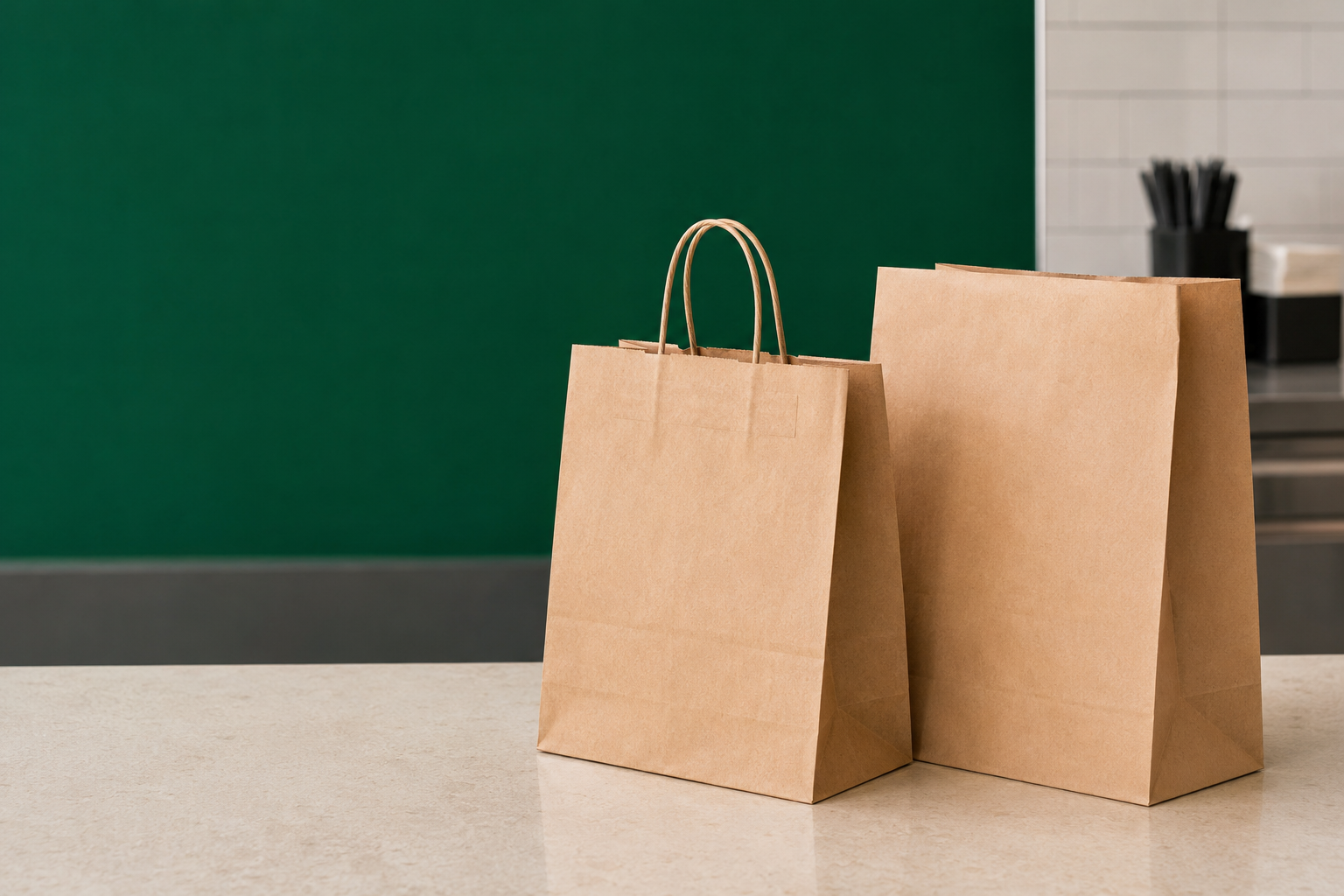
|
◷ THE 30-SECOND VERSION • Choose the bag footprint before deciding whether handles are needed. • Use handled bags when carrying convenience and presentation justify the added material. • Use handleless bags for fast loading, compact storage and short handoffs. • Do not treat handles as proof of greater load capacity. • Test the complete order, including containers, condensation and carrying distance. |
THE HANDLE IS ONLY ONE PART OF THE BAG
A handle changes how a customer carries an order, but it does not correct a bag that is too narrow, too shallow or too light for the contents. The bottom panel and side gussets still determine how containers sit inside the bag. Paper basis weight, seams and handle attachment also affect how the package performs.
That is why the decision should begin with the order profile. Measure the widest container, determine how many items are normally stacked and account for lids, utensils and condiments. Once the correct footprint is established, evaluate whether handles improve the handoff enough to justify the added space and cost.
Side-by-side comparison
|
DECISION FACTOR |
HANDLED BAG |
HANDLELESS BAG |
|
Customer carrying |
Convenient for longer walks and multi-item orders |
Best for short handoffs or orders carried from the bottom |
|
Packing speed |
Handles may need to be opened or arranged |
Wide open top supports quick loading |
|
Storage |
Handles add bulk to each case and packing station |
Generally nests compactly |
|
Presentation |
Often feels more finished for pickup or retail |
Simple, practical service format |
|
Failure point |
Handle attachment can be overstressed |
Top edge can tear if gripped carelessly |
|
Cost control |
Added feature should solve a clear need |
Efficient for high-volume routine orders |
WHEN HANDLES ADD REAL VALUE
Handles are most useful when customers must walk a meaningful distance, carry several containers or keep one hand free. They can also improve pickup organization by giving staff a clear point for moving a completed order from the staging shelf to the customer.
The size range matters because a small handled bag is not a substitute for a large grocery sack, and a large bag can allow containers to shift if the order does not fill the base.
Handles also support a more finished presentation for catering, prepared-food retail and customer-facing pickup. That benefit is operational and experiential, not structural. Staff should still support heavier bags from the bottom and avoid lifting an order by one handle.
WHEN HANDLELESS BAGS WORK BETTER
Handleless grocery sacks and self-opening SOS bags are efficient when staff must open, load and stage orders quickly. Their simple construction allows cases to fit neatly under a counter or beside a packing station. The open top also makes it easy to verify an order before folding the top or handing it to the customer.
They are a strong fit for short counter-to-customer transfers, individually packaged bakery items, smaller prepared-food orders and operations where the customer typically supports the bag from underneath. Different footprints can serve narrow items, standard takeout containers or taller grocery-style loads.
|
💡 QUICK TIP Watch employees during a rush period. If they repeatedly stop to untangle handles, change the pack-out method. If customers struggle to carry multiple handleless bags, test a handled format for that order family. |
FOUR QUESTIONS THAT MAKE THE DECISION EASIER
1 How far will the order travel: A handoff across a counter has different needs than a walk through a parking lot, campus or hospital.
2 What sits on the bottom: The base should match the container footprint so weight is supported evenly instead of pressing into a fold or sidewall.
3 How heavy is the typical order: Do not rely on a size name, paper basis weight or presence of handles as a load rating. Test the actual pack-out.
4 What does the workstation allow: Compare case storage, bag-opening space, staging method and the number of bags packed during peak demand.
|
⚠ COMMON MISTAKE PROBLEM Assuming a handled bag is automatically stronger than a handleless bag. ↓ WHY IT HAPPENS The handle is highly visible, so it can be mistaken for a load-capacity feature. ↓ BETTER APPROACH Evaluate the full construction, footprint and intended use. Run a carry test with the heaviest normal order and support heavier bags from the bottom. |
BUILD A TWO-FORMAT BAG PROGRAM
Many operations do not need to choose one style for every order. A simple program may use an economical handleless bag for routine, short-distance transactions and a handled bag for larger pickup, catering or retail orders. Limiting the approved list to two or three formats keeps purchasing manageable.
Track double-bagging, bag failures, packing time and employee substitutions during a trial. If a more expensive bag prevents double-bagging or improves packing flow, the cost difference may be justified. If handles provide little benefit for the actual handoff, the simpler format may be the better operating choice.
CONCLUSION: MATCH THE CARRY METHOD TO THE ORDER
Handled bags improve convenience and presentation when customers carry larger orders farther. Handleless bags support fast loading, compact storage and efficient short handoffs. Neither format is automatically stronger or more appropriate.
Choose the footprint first, test the complete order and then decide whether handles solve a real customer or workflow need.
|
✓ KEY TAKEAWAY Select handles for a defined carrying benefit, not as a substitute for correct size, construction and load testing. |
Explore Food-Grade Bags
Share:
Five Causes of Takeout Bag Failure—and How to Prevent Them
Match the Wiper to the Mess