
|
◷ THE 30-SECOND VERSION • Identify the mess: water, oil, grease, solvent, particles or dry dust. • Identify the surface: smooth, delicate, rough, edged or heat-affected. • Define the finish: simple removal, low lint, streak-free or ready for coating. • Choose enough wet strength and abrasion resistance for the task. • Verify chemical compatibility and disposal requirements before rollout. |
FIVE QUESTIONS BEFORE YOU PICK A WIPER
1 What is the mess: Water and light spray require different pickup behavior than oil, grease, solvent or metal particles.
2 How much is present: A few drops may need a light towel; a larger spill may require higher absorbency or a dedicated spill-control product.
3 What is the surface: Smooth glass, painted equipment, rough castings and sharp metal edges place different demands on the wipe.
4 What finish is required: General cleanup tolerates more lint than surface preparation, inspection or glass cleaning.
5 How much friction is needed: Blotting places little stress on a sheet; scrubbing dried residue requires wet strength and abrasion resistance.
QUICK-REFERENCE SELECTION CHART
|
MESS / TASK |
PRIORITIZE |
PRACTICAL STARTING POINT |
WATCH FOR |
|
Water and small spills |
Fast pickup |
Light or general-purpose towel |
Overspecifying a heavy cloth |
|
Oil and lubricants |
Absorbency plus wet strength |
Medium-duty industrial wiper |
Smearing or rapid saturation |
|
Heavy grease and grime |
Durability and scrubbing |
Heavy-duty extended-use cloth |
Tearing on rough surfaces |
|
Solvent-assisted cleaning |
Compatibility and integrity |
Tested industrial cloth |
Chemical and disposal rules |
|
Glass and detail work |
Softness and low residue |
Light, low-lint towel |
Streaks, lint or surface scratching |
|
Metal shavings / rough parts |
Tear and abrasion resistance |
Reinforced heavy-duty cloth |
Snagging and embedded particles |
|
Dry dust |
Particle pickup and low lint |
Dry-use wiping material |
Redistributing dust |
WATER-BASED SPILLS: FAVOR FAST PICKUP
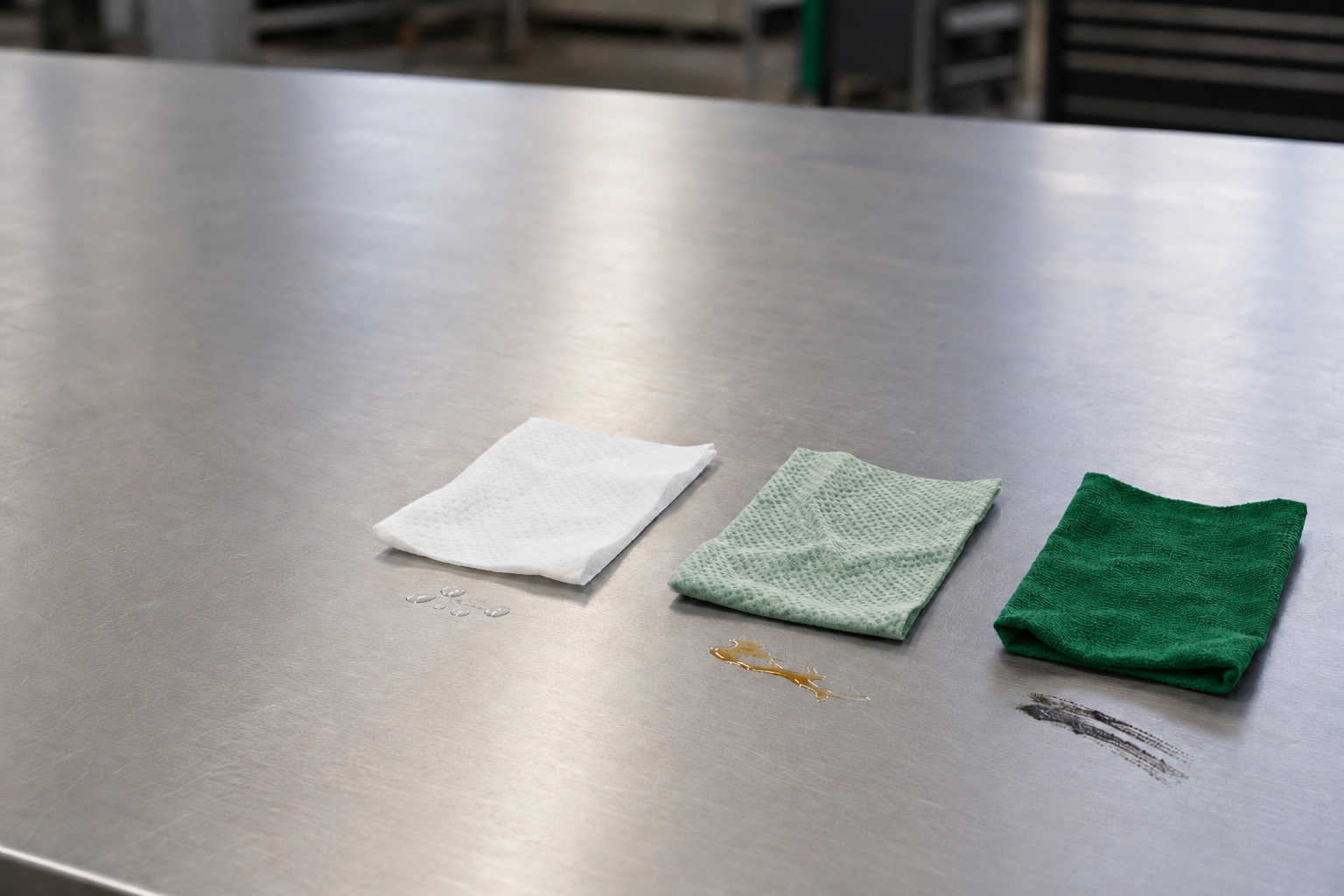
For small water spills, spray-and-wipe cleaning and routine counters, a light or general-purpose towel is often sufficient. The goal is quick pickup without paying for industrial durability the task does not use. WypAll L-Series options are logical starting points for this category.
Increase the grade when the spill volume grows or the same sheet must remain useful through several passes. If a routine spill requires a stack of light towels, a more absorbent general-purpose option may lower total usage. Very large releases should be evaluated as spill-control work rather than ordinary wiping.
OILS AND LUBRICANTS: BALANCE PICKUP AND STRENGTH
Oil can spread across a surface and quickly saturate a weak sheet. Maintenance wiping therefore needs both absorbency and enough wet strength to fold, turn and continue. A moderate X-Series cloth can be an appropriate starting point for tools, equipment and routine lubricant cleanup.
Observe the result after one pass. If the wipe pushes fluid instead of collecting it, saturates immediately or breaks apart, move up in performance. If a heavy-duty cloth remains mostly unused after a small task, move down. The right product should complete the job without excessive reserve capacity.
|
💡 QUICK TIP Fold the wiper into working faces before use. Turning to a clean face can improve control and extend a durable cloth through the task. Do not continue using a contaminated face where cross-transfer would affect quality or safety. |
GREASE, GRIME AND ROUGH SURFACES: PRIORITIZE DURABILITY
Heavy grease and dried residue require friction. Rough castings, machinery and unfinished parts can snag or abrade a lighter towel. This is where a high-strength extended-use cloth, such as an X70 or X80 class, can reduce tearing and repeated sheet changes.
The wiper does not replace the correct cleaner, scraper or protective equipment. It supports the process by carrying loosened soil away. If operators must scrub aggressively, confirm that the surface can tolerate the action and that the wipe will not leave fibers behind.
SOLVENTS AND PROCESS CLEANING: VERIFY COMPATIBILITY
Solvent work adds two decisions: material compatibility and used-wipe management. A cloth may be strong in water but perform differently with a particular solvent. Test the exact wipe and chemical under controlled conditions, following the product instructions and the chemical’s safety data sheet.
Used solvent-contaminated wipes may be subject to specific federal and state requirements. Define the container, labeling, accumulation and disposal or laundering process before placing the product at the workstation. The selection decision should include environmental, health and safety review.
|
⚠ COMMON MISTAKE PROBLEM Choosing one ‘all-purpose’ wiper for every department. ↓ WHY IT HAPPENS A single item simplifies ordering, but the facility’s messes and surfaces may demand conflicting properties. ↓ BETTER APPROACH Create two or three task families—light/general, maintenance and heavy/process—and approve one tested option for each. |
GLASS, FINISHED SURFACES AND DETAIL WORK
Sensitive surfaces change the priority from strength to finish quality. For glass, painted surfaces and final detail work, choose a soft, low-residue option and verify that it does not scratch or leave visible lint. Use a clean sheet and avoid carrying abrasive particles from another task.
Color coding can help separate applications when it is built into a written facility program. For example, departments may assign colors to different work zones or contaminants. Color alone does not establish sanitation or regulatory compliance; training and controlled storage make the system effective.
POINT-OF-USE BUYING CHECKLIST
|
✓ APPROVE THE WIPER ONLY WHEN YOU CAN CHECK EACH BOX • The fluid or soil has been identified. • The surface and finish requirement are documented. • Wet strength and lint performance have been tested. • Sheet size and package format fit the workstation. • Chemical compatibility has been confirmed where applicable. • Used-wipe handling and disposal are defined. • Operators know which task family the wiper serves. |
CONCLUSION: LET THE MESS DEFINE THE MATERIAL
Wiper selection becomes simpler when buyers stop asking for the ‘best’ wiper and start defining the work. Fluid type, volume, surface, finish and friction create a clear performance requirement. That requirement points to an appropriate grade and package format.
A task-based system also improves standardization. Employees know what to use, purchasing can reduce unnecessary overlap, and managers can track consumption by application instead of treating all wipes as interchangeable.
|
✓ KEY TAKEAWAY Match performance to the actual mess. Use lighter towels for routine pickup, stronger cloths for oils and maintenance, heavy-duty options for grease and rough surfaces, and verified materials for solvents or sensitive finishes. |
Explore Wipers
Share:
Handle Bags vs. Handleless Bags
Disposable Wipers vs. Laundered Shop Towels