
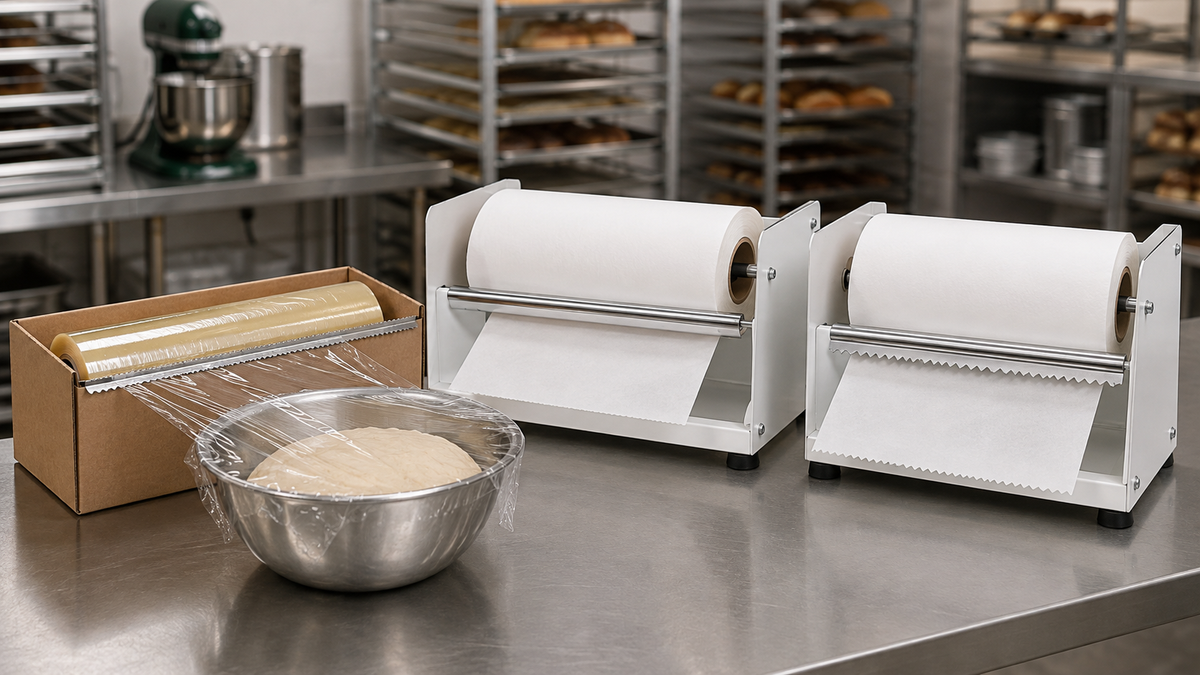
THE 30-SECOND VERSION
- A well-planned wrapping station keeps roll materials accessible and reduces unnecessary movement during bakery preparation and packaging.
- Cling film is useful for covering ingredients, pans, and prepared foods during short-term storage.
- Roll width should match the pans, bowls, and products commonly covered.
- A dedicated dispenser helps control the roll and produce more consistent cuts.
- Always confirm roll width, diameter, core size, and material compatibility before selecting dispensing equipment.
WHY THE WRAPPING STATION MATTERS
Bakery employees may repeatedly cover mixing bowls, ingredient containers, pans, dough, fillings, and prepared products throughout a shift. When film and wrapping materials are stored away from the work area—or left in damaged cutter boxes—each task takes longer and can waste material.
A better setup places the appropriate wrap and dispensing equipment close to the point of use without taking away necessary preparation space.
CHOOSING COMMERCIAL CLING FILM
BuyRight Supply carries Anchor Packaging Cling Film in a 12-inch-wide, 2,000-foot roll. Commercial-length rolls help reduce how frequently employees must replace the material during regular use.
The 12-inch width can be a practical option for covering smaller:
- Mixing bowls
- Ingredient containers
- Prep pans
- Plates and trays
- Portions of dough or prepared food
Before selecting a width, measure the widest part of the containers being covered. The film needs enough additional material to grip the sides without requiring excessive overlap.
For wider pans or trays, using multiple narrow sheets may create a weak seal and increase material consumption. Match the roll width to the bakery’s most common applications rather than choosing based on roll length alone.
WHAT ROLL LENGTH TELLS YOU
Roll length indicates the total amount of material supplied, but it does not predict exactly how long the roll will last. Actual usage depends on:
- The length pulled for each application
- How often employees cover products
- The amount lost through tangled or uneven cuts
- Whether employees use multiple sheets for larger containers
- Seasonal changes in production volume
A 2,000-foot roll contains 24,000 inches of film. If an operation uses approximately 18 inches per application, the theoretical maximum is about 1,333 sheets. Actual yield will be lower because of overlap, trimming, and occasional waste.
Tracking how many rolls are used during a normal week provides a more reliable basis for ordering than estimating from roll length alone.
SELECTING A ROLL DISPENSER
BuyRight also carries Bulman A500 and A501 All-in-One Dispensers for food-service environments. These dispensers are designed to accommodate compatible rolls up to 9 inches in diameter on a 3-inch core.
The primary difference is the cutting style:
| Model | Cutting style | Good starting use |
|---|---|---|
| A500 | Double-sided, spring-loaded tear bar | Paper and other compatible materials needing a smooth, controlled tear |
| A501 | Serrated cutting edge | Compatible flexible materials that benefit from a more aggressive cutting action |
The roll material, not the appearance of the dispenser, should determine which cutting edge is appropriate. Always confirm that the specific film, foil, or paper is compatible with the selected model.
CHECK MORE THAN ROLL WIDTH
A roll can match a dispenser’s stated width and still fail to fit correctly. Confirm all four measurements:
- Roll width: The measurement from one end of the roll to the other.
- Outside diameter: The total diameter of a new, full roll.
- Core diameter: The size of the opening through the center.
- Loaded weight: The full roll’s weight, not the remaining weight of a partially used roll.
BuyRight’s A500 and A501 models accommodate rolls up to 9 inches in diameter with a 3-inch core, but the exact roll material and width must still be matched to the selected dispenser variation.
POSITION THE STATION AROUND THE WORKFLOW
Place wrapping supplies near the tasks where they are used most frequently. A bakery may benefit from one station near ingredient preparation and another near finished-product packaging.
Keep the cutting area clear and position the dispenser so employees can pull material without reaching across food, equipment, or another worker’s path. Frequently used rolls should be easy to replace without disrupting the surrounding workspace.
QUICK CHECK
Before ordering a wrap-and-dispenser combination, confirm:
- The wrap is suitable for the intended food-service application.
- The roll width covers the bakery’s common containers.
- The outside diameter fits the dispenser.
- The roll has the required 3-inch core.
- The cutting edge is appropriate for the material.
- The dispenser fits safely at the intended workstation.
- Employees can load and operate it consistently.
KEY SUMMARY
An efficient bakery wrapping station begins with matching the material to the task. BuyRight’s 12-inch by 2,000-foot Anchor Cling Film provides a commercial-length option for covering smaller containers, pans, and prepared foods. Bulman A500 and A501 food-service dispensers provide controlled roll handling for compatible materials, with different cutting-edge designs for different applications.
Checking width, outside diameter, core size, cutting method, and workstation placement together can reduce wasted material and make daily bakery preparation more efficient.
Share:
How to Choose the Right Commercial Broom, Mop, Duster, and Cleaning Accessories
Bakery Tissue vs. Wax Deli Paper: Which Should You Use?