
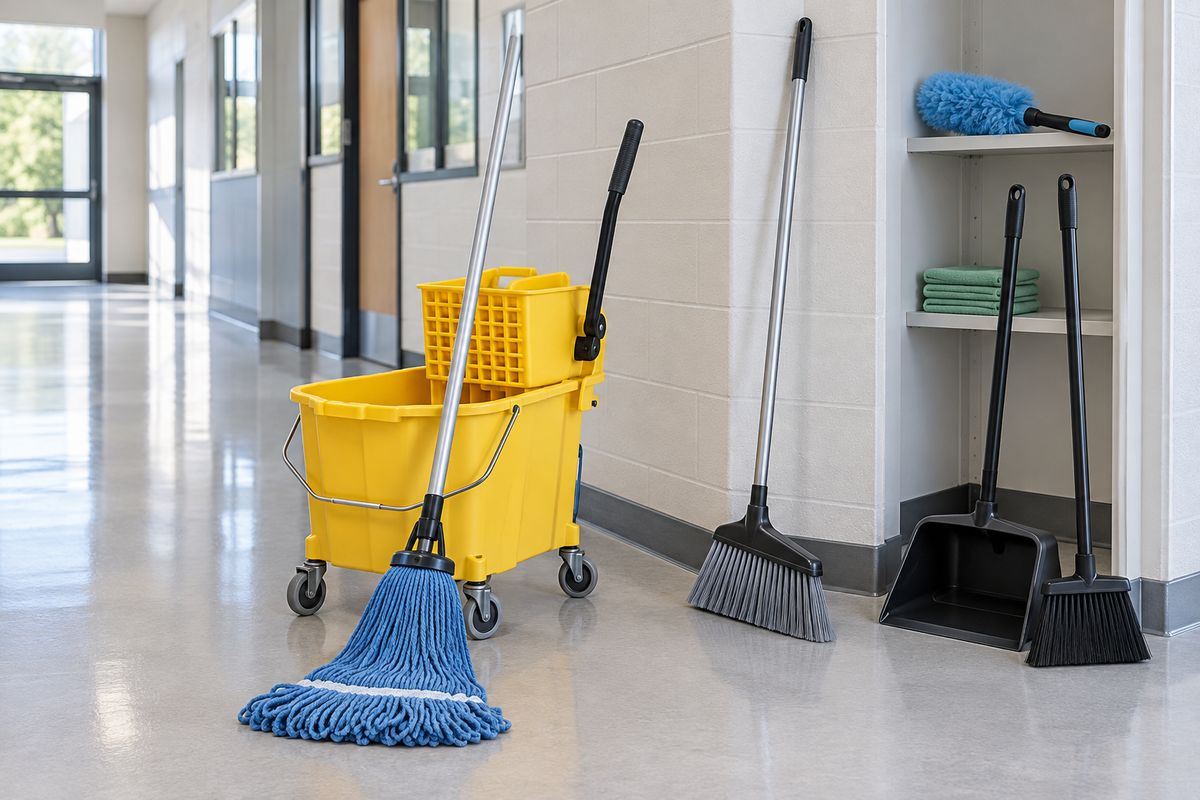
THE 30-SECOND VERSION
- Choose cleaning tools based on the debris, floor surface, size of the area, and frequency of use.
- Angle brooms help clean corners and edges, while warehouse brooms handle larger, heavier debris.
- Lobby broom and dustpan sets make quick cleanup easier in customer-facing spaces.
- Loop-end wet mops are designed for repeated commercial floor cleaning.
- Mop handles, buckets, and wringers must be compatible with the selected mop head.
- Dusters help remove fine dust from surfaces that sweeping and mopping cannot reach.
- The right combination of tools can make cleaning faster, more consistent, and less physically demanding.
START WITH THE CLEANING TASK
Commercial cleaning tools are not interchangeable. A broom designed for an office lobby may struggle with debris on a warehouse floor, while a heavy warehouse broom can be unnecessarily large for cleaning around desks or furniture.
Before selecting brooms, mops, dusters, or accessories, identify:
- The type and amount of soil or debris
- Whether the surface is smooth, textured, wet, or dry
- The size of the cleaning area
- How often the task is performed
- Whether cleaning takes place around customers or employees
- How the tools will be stored and maintained
Matching each tool to its intended task helps cleaning teams work more efficiently and can reduce premature wear.
ANGLE BROOMS VS. WAREHOUSE BROOMS
Angle brooms have bristles cut at an angle, allowing the broom to reach along walls, under equipment, and into corners. They are useful for offices, classrooms, kitchens, restrooms, and other areas where cleaners must work around furniture and fixtures.
Larger commercial angle brooms provide more sweeping coverage while maintaining the angled edge needed for detailed cleaning.
Warehouse brooms are better suited to open work areas and heavier debris. A blended corn warehouse broom, for example, can help collect dust, dirt, scraps, and other dry materials on warehouse, manufacturing, or facility floors.
| Broom Type | Best Used For |
|---|---|
| Angle broom | Corners, edges, furniture, fixtures, and detailed sweeping |
| Large angle broom | Wider areas that still require control around obstacles |
| Lobby broom | Quick cleanup in entrances, dining areas, offices, and public spaces |
| Warehouse broom | Larger dry debris and routine sweeping in industrial environments |
The best broom is not necessarily the largest or stiffest option. It should move the expected debris without scattering it or requiring unnecessary effort.
WHEN TO USE A LOBBY BROOM AND DUSTPAN
Lobby broom and upright dustpan combinations are designed for fast, visible cleanup. They allow employees to collect debris without repeatedly bending down, making them especially helpful in retail stores, restaurants, schools, offices, and building entrances.
These sets work well for small messes that need immediate attention but do not justify bringing out larger cleaning equipment. An upright dustpan may also help contain debris while it is carried to a waste receptacle.
For less frequent use or larger cleanup tasks, a standard heavy-duty plastic dustpan paired with an appropriate broom may be sufficient.
CHOOSING A COMMERCIAL WET MOP
Wet mops are commonly used for routine floor cleaning, spill response, and applying cleaning solutions. Mop head construction affects coverage, absorbency, durability, and how easily the mop can be wrung out.
Blended loop-end mops are a practical choice for many commercial facilities. The looped yarn helps reduce loose strands and tangling compared with cut-end designs, while blended fibers can provide a useful balance of absorbency and strength.
Consider the following when selecting a mop:
- Floor type and size
- Amount of liquid or soil being collected
- Required absorbency
- Frequency of laundering or replacement
- Mop-head size and weight
- Compatibility with the handle and wringer
Using an oversized mop in a small room can make cleaning harder. A mop that is too small for a large facility can increase the time and effort required to complete the job.
MOP BUCKETS AND SIDE-PRESS WRINGERS
A commercial mop system includes more than the mop head. The bucket, wringer, and handle must work together.
Side-press wringers use a lever to apply pressure to the mop head and remove excess liquid. They are a familiar option for schools, healthcare facilities, offices, restaurants, and other commercial buildings.
A properly matched mop bucket and wringer can help:
- Control the amount of solution applied to the floor
- Reduce dripping during transportation
- Make wringing more consistent
- Limit unnecessary bending and hand contact
- Improve movement between cleaning areas
Features such as stable casters, an easy-to-use wringer, and a durable bucket become especially important when the system is used throughout the day.
DO NOT OVERLOOK MOP-HANDLE COMPATIBILITY
A mop head and handle can appear compatible without connecting securely. Jaw-clamp mop handles are designed to grip compatible mop heads and allow replacement when the head becomes worn or needs to be laundered.
Before ordering, confirm the mop head’s band style, size, and attachment requirements. A secure connection helps prevent the mop head from shifting or detaching during use.
Replace handles that have damaged clamps, sharp edges, corrosion, or loose components. Continuing to use a worn handle can make cleaning less efficient and may damage replacement mop heads.
WHERE DO DUSTERS FIT INTO A CLEANING PROGRAM?
Brooms and mops focus primarily on floors, but dust also collects on desks, shelving, vents, fixtures, blinds, equipment, and other elevated surfaces.
Disposable and reusable dusters are designed to capture fine particles from areas that may be difficult to clean with cloths alone. Flexible duster heads can help reach around objects and into narrow spaces without moving every item.
Dust higher surfaces before sweeping or mopping the floor. This simple sequence allows fallen particles to be collected during the final floor-cleaning step instead of creating additional work.
MATCHING TOOLS TO YOUR FACILITY
Different areas within the same building may require different tools.
| Facility Area | Useful Cleaning Tools |
|---|---|
| Lobby or entrance | Lobby broom, upright dustpan, duster |
| Classroom or office | Angle broom, duster, compact wet mop |
| Restaurant or cafeteria | Angle broom, lobby dustpan, wet mop and wringer |
| Warehouse | Warehouse broom, heavy-duty dustpan, larger mop system |
| Healthcare or commercial building | Duster, dedicated mop system, compatible replacement heads |
| Restroom | Dedicated wet mop, bucket, wringer, and separate cleaning accessories |
Using designated or color-coded tools for different areas may help reduce the chance of transferring soils between spaces. Facilities should follow their own cleaning, sanitation, and infection-control procedures where applicable.
COMMON MISTAKE
One common mistake is purchasing each component separately without checking compatibility. Mop heads, handles, buckets, and wringers should function as a complete system.
Another mistake is expecting one broom or mop to handle every area of a facility. A small selection of task-specific tools usually provides better results than relying on one general-purpose option for every surface and type of debris.
QUICK TIP
Create a simple equipment list for each cleaning zone. Record the broom type, mop-head style, handle connection, bucket or wringer model, and replacement schedule. This makes reordering easier and helps employees return the correct tools to each area.
SELECTION CHECKLIST
Before ordering commercial cleaning tools, ask:
✓ What kind of debris or soil needs to be removed?
✓ Is the surface smooth, textured, wet, or dry?
✓ Does the tool need to reach corners or clean a large open area?
✓ Are the mop head, handle, bucket, and wringer compatible?
✓ Will the equipment be used in a public or customer-facing space?
✓ Does the facility need separate tools for different cleaning zones?
✓ Are replacement heads and accessories readily available?
KEY TAKEAWAY
The right commercial broom, mop, duster, or accessory is determined by the task—not simply by price or size. Angle brooms support detailed sweeping, warehouse brooms handle larger dry debris, lobby sets simplify quick cleanup, wet mops clean floors, and dusters reach surfaces that floor tools cannot.
Selecting compatible, task-specific cleaning tools helps facilities maintain cleaner spaces while improving efficiency and consistency.
CONCLUSION
A strong facility-cleaning program starts with dependable tools matched to the surfaces and messes employees encounter every day. Evaluating the cleaning area, debris type, tool compatibility, and frequency of use makes it easier to select equipment that performs reliably.
BuyRight Supply offers commercial brooms, dusters, mops, mop buckets, wringers, handles, dustpans, and related accessories for offices, schools, restaurants, warehouses, healthcare facilities, and other commercial environments.
Share:
Cup and Lid Compatibility: How to Prevent Leaks, Spills, and Ordering Mistakes
How to Build a More Efficient Bakery Wrapping Station