
|
THE 30-SECOND VERSION
|
|
WHAT BUBBLE SIZE ACTUALLY CHANGES |
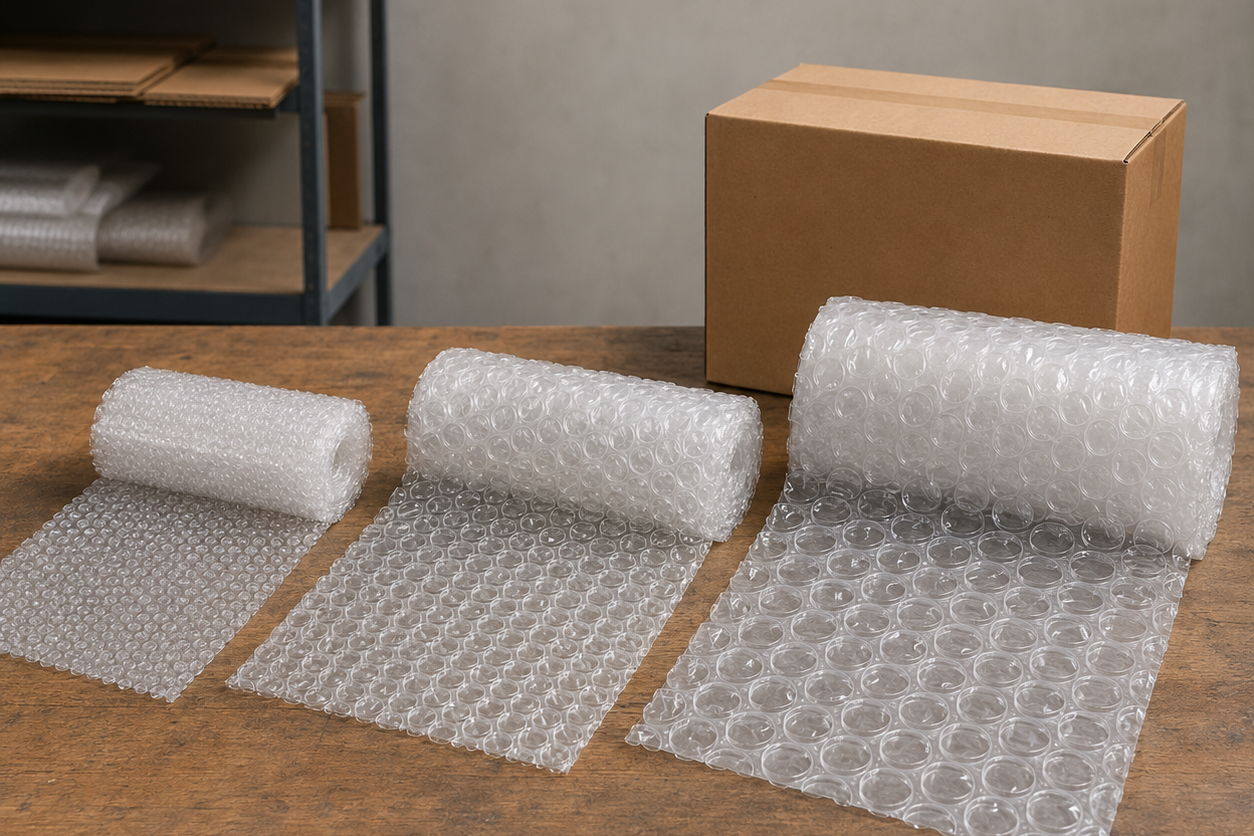
Bubble diameter and height influence how the material conforms to a product and how much impact distance it creates. Smaller bubbles bend around corners and details. Larger bubbles create thicker cushioning with fewer wraps, but they need more room and may not contact small contours evenly.
The goal is not to select the largest bubble available. It is to create enough cushioning distance without making the carton oversized or leaving high-risk areas unsupported.
|
BUBBLE SIZE SELECTION GUIDE |
|
Relative size |
Best use |
Advantages |
Limitations |
|
Small bubble |
Light products, surface protection, detailed shapes |
Conforms closely; compact package |
Less impact distance per layer |
|
Medium bubble |
General-purpose cushioning |
Balances flexibility and protection |
May need added layers for fragile goods |
|
Large bubble |
Large items and void reduction |
Builds depth quickly; fills space |
Bulky; less precise around small features |
|
DID YOU KNOW? Bubble diameter and film strength are separate specifications. Two products with similar-looking bubbles may perform differently when exposed to weight, sharp edges or long shipping cycles. |
|
THICKNESS, STRENGTH AND AIR RETENTION |
Suppliers may describe bubble wrap by film gauge, grade, barrier construction or performance category. Terminology is not always standardized across manufacturers, so compare the product specification rather than relying only on words such as “heavy duty.”
Thicker or stronger film generally resists punctures and tearing better. Barrier layers can improve air retention, which matters when packages remain in transit or storage for extended periods. Sharp corners, exposed hardware and concentrated loads may still require corrugated pads, foam or edge protectors.
|
USE PRODUCT RISK TO SET THE STARTING POINT |
|
Risk factor |
What it means |
Practical response |
|
Low weight, low fragility |
Limited impact energy |
Start with small bubble and verify movement control |
|
Moderate weight or fragility |
More energy must be absorbed |
Use medium bubble or multiple small-bubble layers |
|
Large but lightweight item |
Needs clearance more than dense cushioning |
Consider large bubble to build space efficiently |
|
Heavy, sharp or highly fragile |
High puncture or bottom-out risk |
Use stronger bubble plus engineered corner/foam support |
|
A FIVE-STEP SELECTION METHOD |
1. Identify vulnerable surfaces, corners, protrusions and internal components.
2. Estimate the product’s fragility and the severity of the handling environment.
3. Measure the clearance available between the product and every carton wall.
4. Choose a bubble size that conforms to the product while providing sufficient cushioning depth.
5. Pack a sample, perform a gentle shake test and run an appropriate drop-test protocol before standardizing the method.
|
QUICK TIP If a pack requires many layers just to fill empty space, the carton may be too large. Correcting the box size can reduce both labor and bubble-wrap consumption. |
|
LAYERING WITHOUT WASTING MATERIAL |
More layers are not automatically better. Once the material is compressed tightly against the carton wall, the bubbles have less room to absorb energy. Wrap evenly, avoid flattened sections and maintain clearance around the most vulnerable areas.
For items with different risk zones, use targeted reinforcement. Add an extra wrap around a fragile handle or control panel instead of doubling material over the entire product. Foam or corrugated corner guards may be more effective than additional bubble wrap at hard edges.
|
COMMON SELECTION MISTAKES |
· Choosing by bubble diameter alone and ignoring film durability.
· Using small bubble to fill a large carton void instead of correcting box size.
· Allowing tape, staples or sharp product edges to puncture the material.
· Reusing bubble wrap after it has lost air or developed tears.
· Skipping a pack test because the item feels secure at the workstation.
|
ADJUST FOR SHAPE AND HANDLING |
Product geometry can matter as much as weight. Small bubbles follow handles, fittings and uneven surfaces more closely, reducing unsupported pockets. Large, flat products may benefit from larger bubbles or pads that create consistent separation without repeated wrapping.
Also consider how the package will be handled. A carton moving on a dedicated local route may experience fewer drops than a parcel shipped through multiple sorting facilities. The more demanding route may justify stronger film, better air retention or a combined system with foam and corner protection.
When one bubble specification is used for many products, organize items into risk groups rather than applying the same number of wraps to everything. A small set of verified pack methods is easier to train, purchase and audit than dozens of improvised combinations.
|
CONCLUSION |
Select bubble wrap by balancing conformity, cushioning depth, durability and carton space. Small bubbles suit close wrapping, medium bubbles cover many general applications and large bubbles build clearance quickly. Product weight and fragility then determine whether stronger film, added layers or complementary supports are necessary.
|
KEY TAKEAWAY Choose the smallest bubble size and lightest construction that consistently passes your packaging test. That standard protects the product while controlling material and freight costs. |
Explore Bubble/Foam/Loosefill
Share:
How Much Protective Packaging Does Your Shipment Actually Need?
Bubble Wrap vs. Foam vs. Loose Fill: Which Protective Packaging Should You Use?