
|
THE 30-SECOND VERSION
|
|
START WITH THE DAMAGE RISK—NOT THE MATERIAL |
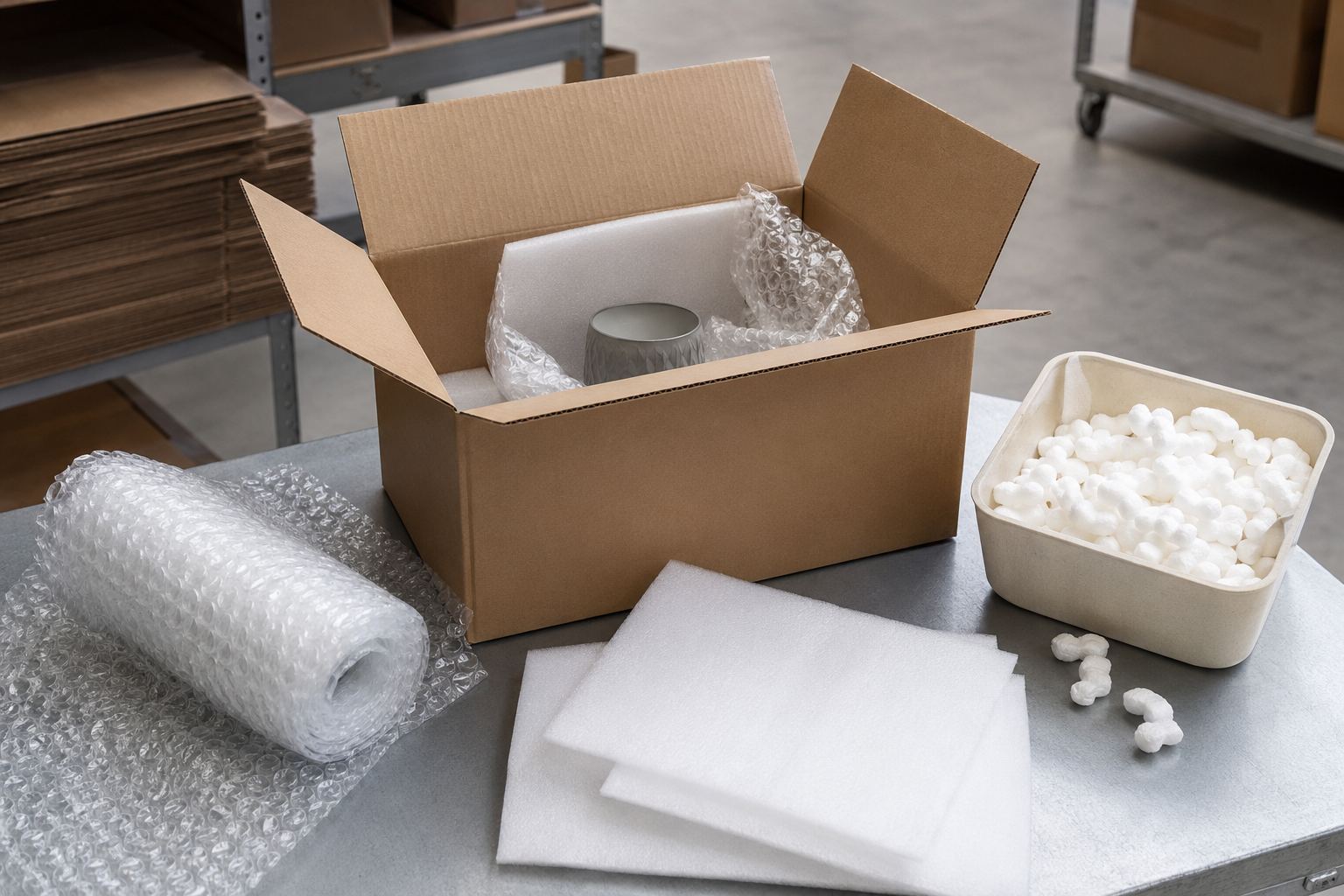
Protective packaging has three separate jobs: prevent movement, absorb impact and protect surfaces. A material can perform more than one job, but no single option is ideal in every carton. A painted component may need abrasion protection from foam even if it is not fragile. A ceramic item may need bubble cushioning plus paper or loose fill to keep the wrapped item centered.
Begin by identifying what could realistically go wrong during handling: dropping, vibration, compression, scratching or shifting. This keeps the decision tied to product risk instead of habit.
|
QUICK COMPARISON |
|
Material |
Best at |
Good fit |
Watch for |
|
Bubble wrap |
Impact cushioning |
Glassware, parts, moderately fragile goods |
Large bubbles can mark soft surfaces; insufficient layers can bottom out |
|
Foam |
Surface and abrasion protection |
Finished metal, furniture parts, electronics housings |
Thin foam alone may not absorb a hard drop |
|
Loose fill |
Filling irregular voids |
Lightweight, odd-shaped products in roomy cartons |
Can shift in transit and allows heavy items to settle |
|
WHEN BUBBLE WRAP IS THE BETTER CHOICE |
Bubble wrap works by trapping air in flexible cells that compress under impact. It is useful when an item needs a protective envelope around multiple sides, especially when the shape is difficult to support with flat pads.
· Wrap the item with bubbles facing inward when the surface is durable and the goal is close cushioning.
· Use enough layers that vulnerable areas cannot be felt easily through the wrap.
· Secure the wrap so it stays in place, but avoid tape directly on the product.
· Add corner or edge protection when those areas will take the first impact.
|
QUICK TIP A wrapped product can still be damaged if it moves inside the carton. After cushioning the item, fill remaining space and perform a gentle shake test. |
|
WHEN FOAM IS THE BETTER CHOICE |
Foam sheet and roll products create a smooth barrier between the product and the carton. They are particularly useful for painted, polished, coated or otherwise appearance-sensitive surfaces. Foam also adds light cushioning without greatly increasing package dimensions.
Use foam as the first layer around a scratch-sensitive item, then add bubble wrap or another cushioning material when drop protection is also required. For flat parts, separators made from foam can prevent stacked pieces from rubbing during vibration.
|
WHEN LOOSE FILL IS THE BETTER CHOICE |
Loose fill flows into irregular spaces, making it convenient for light products with shapes that leave uneven voids. It is fast to add and can help keep a pre-wrapped item away from carton walls. It is less reliable with dense products because vibration can cause the item to migrate downward while the fill rises.
|
COMMON MISTAKE Problem: treating loose fill as complete cushioning. ↓ Why it happens: a full-looking carton appears protected even when the product can settle. ↓ Better approach: wrap or brace fragile items first, then use loose fill only to occupy remaining space. |
|
BUILD THE RIGHT MATERIAL SYSTEM |
|
Product condition |
Primary layer |
Secondary control |
|
Fragile and durable surface |
Bubble wrap |
Void fill to center the item |
|
Scratch-sensitive, moderately fragile |
Foam against surface |
Bubble wrap or pads outside foam |
|
Lightweight, irregular and not fragile |
Bag or light wrap if needed |
Loose fill to control movement |
|
Heavy or sharp-edged |
Dense foam, corner blocks or engineered support |
Minimal void fill; use a stronger carton |
Use the smallest carton that still provides the required cushioning clearance. Oversized cartons increase material use, labor and dimensional shipping cost. Undersized cartons leave too little distance between the product and the outer wall to absorb an impact.
|
THREE REAL-WORLD SELECTION EXAMPLES |
A powder-coated metal panel is not especially fragile, but a visible scratch can make it unacceptable. A thin foam sheet against the finish, with corrugated separators between panels, addresses the primary risk more directly than several layers of bubble wrap.
A glass dispenser component needs impact cushioning and movement control. Bubble wrap should surround the component, while paper or another void-fill material keeps the wrapped piece centered. Loose fill can occupy irregular gaps, but it should not replace the protective wrap.
A lightweight molded plastic part with an irregular shape may need little impact protection. If the carton is properly sized, modest loose fill can prevent rotation and contact with the walls. This is a case where extra wrapping would add labor without solving a meaningful risk.
|
CONCLUSION |
The best protective packaging choice is the one matched to the actual failure mode. Choose bubble wrap for impact cushioning, foam for surface protection and low-profile separation, and loose fill for irregular voids around light, already-protected items. Many shipments need a simple combination rather than one material used in excess.
|
KEY TAKEAWAY Protect the product first, control movement second, and verify the pack with a repeatable test. That sequence improves consistency while reducing unnecessary material. |
Explore Bubble/Foam/Loosefill
Share:
How to Choose the Right Bubble Wrap Size and Thickness
How to Create a Better Restroom Inspection Checklist