
THE 30-SECOND VERSION
• General industry requires protective helmets where falling objects could injure the head.
• Electrical-rated head protection is required near exposed conductors that could contact the head.
• Construction requirements also address impact, falling or flying objects, electrical shock and burns.
• Employers must select compliant, properly fitting PPE and train employees to use and care for it.
• A “hard hat area” rule should be based on the hazard assessment and enforced consistently.
THE CORE GENERAL-INDUSTRY RULE
Under 29 CFR 1910.135, employers must ensure that each affected employee wears a protective helmet in areas where falling objects could injure the head. Employers must also ensure that affected employees wear a helmet designed to reduce electrical shock hazard when exposed conductors could contact the head. These requirements work with the broader PPE duties in 1910.132.
The rule focuses on exposure, not department names. A warehouse employee may need head protection beneath overhead storage or near hoisted loads, while an office employee entering the same controlled area may also become an affected employee. Access, duration and job title do not eliminate the hazard.
CONSTRUCTION REQUIREMENTS
For construction, 29 CFR 1926.100 requires protective helmets where employees face possible head injury from impact, falling or flying objects, or electrical shock and burns. The construction PPE criteria in 1926.95 require necessary PPE to be provided, used and maintained in a sanitary and reliable condition. Current construction rules also expressly require PPE to properly fit each affected employee.
A site may use additional hard-hat rules to simplify control of changing overhead hazards. A broad site policy can be reasonable when exposures shift frequently, but it should be documented, communicated and aligned with applicable standards and the employer’s safety program.
START WITH A PPE HAZARD ASSESSMENT
General-industry employers must assess the workplace to determine whether hazards are present or likely to be present that require PPE. For head protection, the review should consider falling materials, overhead work, hoists and cranes, low clearances, protruding objects, flying debris, electrical conductors and tasks where slips or falls could create head impact.
✓ Observe routine work and nonroutine maintenance.
✓ Review injuries, near misses and damaged-product reports.
✓ Consider contractors, visitors and employees who cross the area.
✓ Evaluate electrical exposure separately from impact exposure.
✓ Document the selected helmet type, class and required accessories.
✓ Repeat the assessment when equipment, layout or processes change.
WHAT COUNTS AS COMPLIANT HEAD PROTECTION?
OSHA 1910.135 identifies editions of ANSI Z89.1 that may be used for compliance and permits head protection that provides equivalent or greater protection when the employer demonstrates it. The helmet’s markings and manufacturer documentation are the practical evidence of its tested type and class. A bump cap is not a substitute when the hazard requires a protective helmet.
Selection must go beyond the compliance stamp. Type I and Type II address impact direction; Classes G, E and C address electrical performance. The employer must match those characteristics to the assessed hazards and ensure that accessories do not compromise the tested system.
|
EMPLOYER DUTY |
PRACTICAL ACTION |
|
Assess hazards |
Identify impact, falling-object, flying-object and electrical exposures. |
|
Select protection |
Verify standard, type, class, fit and approved accessories. |
|
Provide and require use |
Issue appropriate PPE and enforce it in the hazard area. |
|
Train employees |
Explain when PPE is needed, how to wear it, its limits and care. |
|
Maintain reliability |
Inspect, clean, store and replace damaged equipment promptly. |
FIT, TRAINING AND EMPLOYEE-OWNED EQUIPMENT
PPE must fit the person who wears it. A loose helmet can shift out of position; an overtightened suspension can be uncomfortable and discourage consistent use. Stock enough sizes or adjustment ranges to fit the workforce, and evaluate chin straps when the work could dislodge the helmet. Use only compatible components.
Training should cover when head protection is necessary, what kind is required, how to put it on and adjust it, its limitations, and proper care and useful life. Retraining is needed when workplace changes make earlier training obsolete or when employee behavior shows that knowledge or skill has not been retained.
Employee-owned PPE does not transfer responsibility away from the employer. The employer must ensure its adequacy, proper maintenance and sanitation. A personal helmet that lacks the necessary rating, has unapproved modifications or cannot be inspected should not enter the hazard area.
⚠ COMMON MISTAKE
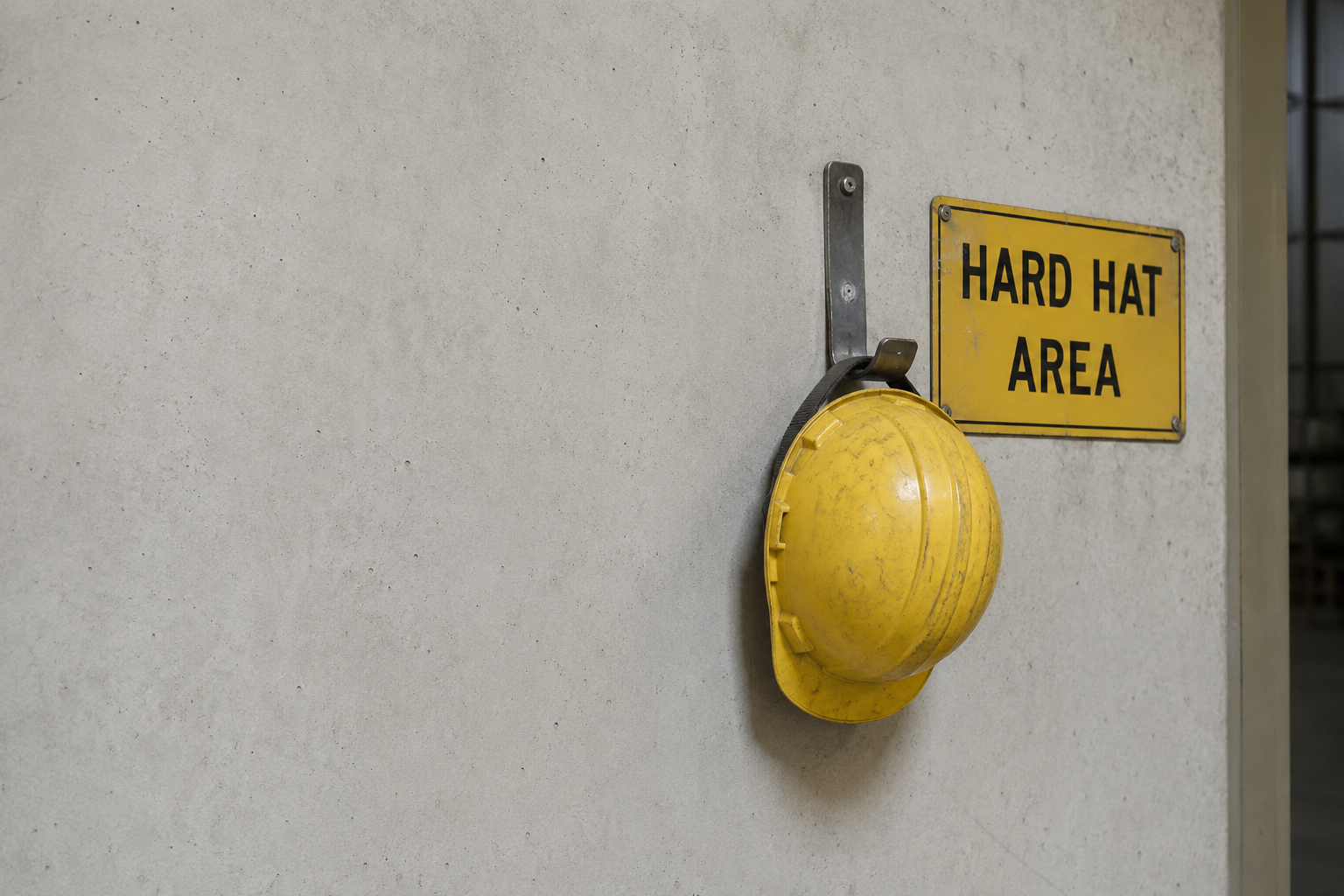
Problem: A facility posts “Hard Hat Area” signs but never defines the boundary or reason.
↓ Why it happens: Signage is easier than completing a hazard-based program.
↓ Better approach: Map the exposure, mark a clear entry point, specify the required type/class, train affected people and verify compliance.
WHAT OSHA DOES NOT SPECIFY UNIVERSALLY
OSHA does not create one universal hard-hat color code for job roles, one replacement date for every model or a blanket rule that every sticker is prohibited. Color systems are generally employer programs. Replacement depends on impact, condition, exposure and manufacturer instructions. Paints and adhesives require manufacturer guidance because they may damage the shell or hide defects.
KEY TAKEAWAY
OSHA compliance begins with the hazard assessment. Select head protection that meets the applicable criteria and matches the impact and electrical exposure, provide a proper fit, train affected employees and maintain the equipment in reliable condition.
CONCLUSION
A defensible hard-hat program connects each rule to an observed hazard and a practical control. Define where protection is required, choose the correct type and class, make compliant equipment available in suitable sizes, and build inspection and replacement into normal operations. Regulatory references: OSHA 29 CFR 1910.132 and 1910.135; 29 CFR 1926.95 and 1926.100; OSHA Head Protection: Safety Helmets in the Workplace. This article is educational and does not replace a site-specific compliance review.
Explore Hard Hats
Share:
How to Choose the Right Safety Vest for Your Jobsite
7 Signs a Hard Hat Is No Longer Safe to Use