
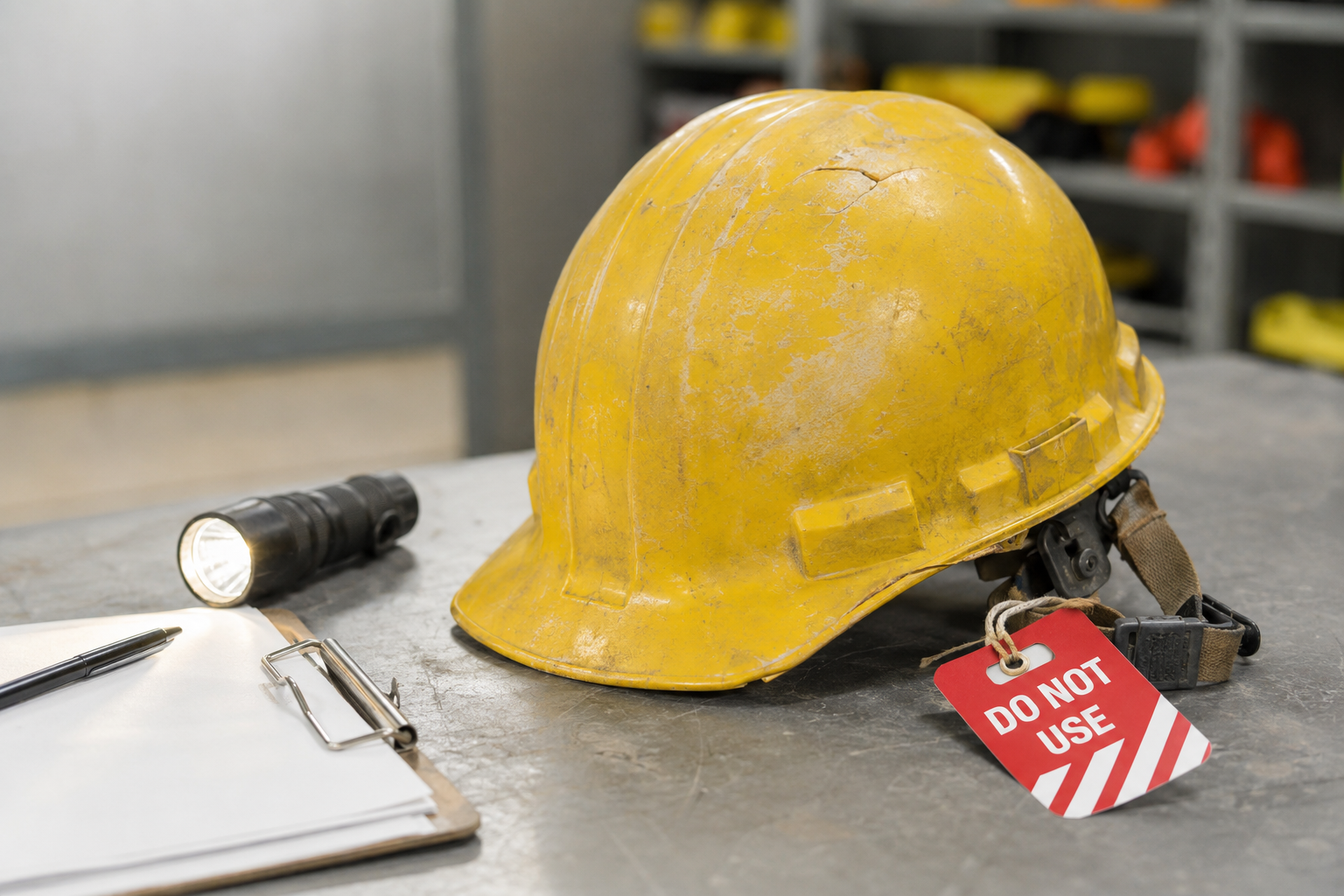
THE 30-SECOND VERSION
• Remove a helmet after a significant impact, even if damage is not obvious.
• Reject cracks, splits, punctures, deformation and brittle or chalky shells.
• Inspect the suspension, adjustment system and attachment points separately.
• Check chemical, heat and UV exposure history.
• Follow the manufacturer’s replacement guidance; do not invent one universal expiration date.
INSPECT THE WHOLE SYSTEM
A hard hat protects through the combined action of the outer shell and the suspension system. The shell helps resist and distribute force; the suspension creates clearance and manages energy before the shell reaches the head. A good-looking shell paired with a stretched suspension is not a complete protective system.
Inspect before use and whenever the helmet may have been struck, dropped, exposed to chemicals or stored in extreme conditions. Clean it according to manufacturer instructions so damage is visible. If the history is unknown and the condition is questionable, remove it from service until a competent person or the manufacturer can evaluate it.
1. IT HAS TAKEN A SIGNIFICANT IMPACT
A helmet may absorb energy without leaving an obvious dent. If it was struck by a falling object, involved in an incident or subjected to an impact beyond normal handling, follow manufacturer instructions and replace it when directed. Do not rely on appearance alone or return it to circulation because “it still looks fine.”
2. THE SHELL IS CRACKED, SPLIT OR PUNCTURED
Hairline cracks can grow under flexing, cold or another impact. Inspect the crown, brim, accessory slots and suspension attachment areas under good light. Any split, puncture or crack is a clear reason to stop using the helmet. Do not drill holes or make field repairs with glue, tape or heat.
3. THE SHELL IS DENTED, WARPED OR MISSHAPEN
Heat exposure, crushing during storage or chemical contact can deform the shell. Look for a brim that no longer sits evenly, a crown that has flattened or areas that flex differently from the surrounding material. Shape changes can alter clearance and force distribution.
4. THE SURFACE IS CHALKY, FADED OR BRITTLE
Sunlight and weather can age thermoplastic shells. Heavy fading, a chalky appearance, flaking or unusual brittleness can indicate deterioration. Compare questionable helmets with a known-good example of the same model, and follow the manufacturer’s service-life guidance for UV and environmental exposure.
💡 QUICK TIP
Gently flex only as the manufacturer permits. Never use an aggressive “snap test” that could damage the shell. Visual inspection, exposure history and manufacturer instructions are the safer decision tools.
5. THE SUSPENSION IS TORN, STRETCHED OR FRAYED
Inspect webbing, sweatbands, stitching, clips and the crown straps. Torn fibers, stretched straps, damaged clips or improvised replacements can reduce the designed clearance. Replace the suspension only with the correct manufacturer-approved part; a component that fits physically may not be tested as part of that helmet system.
6. IT WILL NOT ADJUST OR STAY SECURE
A stripped ratchet, cracked headband or slipping adjustment can let the helmet move or fall off. The helmet should fit securely without excessive pressure and remain properly positioned during normal work. A chin strap may be appropriate for some tasks, but it must be compatible and does not repair a failed adjustment system.
7. CHEMICAL, PAINT OR UNAUTHORIZED MODIFICATION IS SUSPECTED
Solvents, paints, adhesives, cleaners and aftermarket modifications may weaken the shell or hide damage. OSHA does not categorically prohibit every sticker, but users must follow manufacturer instructions and ensure decorations do not interfere with inspection or reliability. Unknown chemical exposure is a reason to isolate the helmet and seek guidance.
⚠ COMMON MISTAKE
Problem: Every hard hat is replaced on one universal calendar date.
↓ Why it happens: A simple date is easier to administer.
↓ Better approach: Follow model-specific manufacturer guidance, track issue and exposure history, inspect before use and replace immediately when condition or impact requires it.
REMOVE-FROM-SERVICE CHECKLIST
✓ Flag the helmet so another worker cannot pick it up.
✓ Record the reason for removal when the facility tracks PPE life cycle.
✓ Replace the shell, suspension or complete system as the manufacturer directs.
✓ Do not mix components from different manufacturers unless expressly approved.
✓ Review whether storage, chemicals or work practices caused premature damage.
✓ Issue a properly fitting replacement before the worker returns to the hazard area.
KEY TAKEAWAY
If you cannot verify the helmet’s condition, impact history or compatibility, do not gamble with it. Remove it from service and use the manufacturer’s instructions to decide whether a component or the entire helmet must be replaced.
CONCLUSION
A short inspection is valuable because head protection is often called on without warning. Teach workers what normal condition looks like, provide a simple removal process and keep approved replacement parts available. The goal is not to stretch every helmet to a date—it is to ensure every helmet issued remains sanitary, reliable, compatible and appropriate for the hazard. Regulatory references: OSHA 29 CFR 1910.132 and 1910.135; OSHA PPE guidance and manufacturer instructions.
Explore Hard Hats
Share:
OSHA Hard Hat Requirements Explained
Hard Hat Classes G, E and C Explained