
THE 30-SECOND VERSION
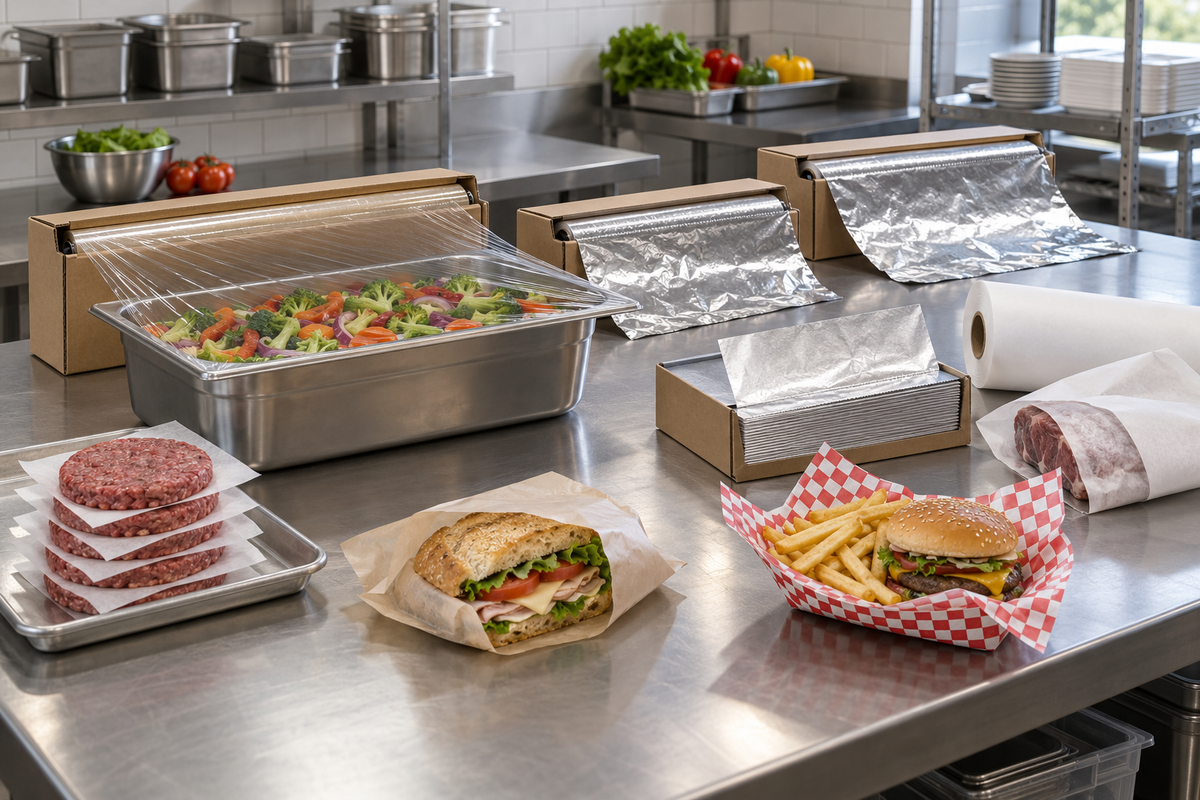
- Plastic cling film is useful for covering containers and protecting refrigerated foods.
- Aluminum foil handles heat, blocks light, and holds its shape around food and pans.
- Heavy-duty foil provides greater resistance to tearing and punctures.
- Wax deli paper and grease-resistant liners help manage oils and moisture during serving.
- Patty paper separates portions and helps prevent foods from sticking together.
- Freezer paper is intended for longer-term frozen storage when properly wrapped.
- Choose food wrap based on temperature, moisture, grease, storage time, and how the food will be handled.
WHY THE RIGHT FOOD WRAP MATTERS
Food wrap does more than cover a product. It can protect food during storage, support temperature control, separate portions, improve presentation, and simplify preparation.
Using the wrong material can lead to torn wraps, leaks, freezer damage, softened paper, or unnecessary product waste. The best option depends on what is being wrapped, how long it must remain protected, and whether it will be stored, transported, reheated, or served immediately.
BuyRight Supply offers commercial cling film, aluminum foil, deli and bakery papers, patty paper, basket liners, freezer paper, and butcher paper for a variety of food-service operations.
PLASTIC CLING FILM
Cling film is a flexible, transparent material that stretches across containers and adheres closely around food and smooth surfaces. Its transparency allows employees to identify contents without removing the covering.
Commercial cling film is commonly used for:
- Covering food pans and bowls
- Protecting prepared ingredients
- Wrapping produce
- Separating or bundling refrigerated items
- Short-term food storage
- Preparing items for refrigerated service
Cling film works best when the correct width is matched to the container or work area. A roll that is too narrow may require overlapping layers, while an unnecessarily wide roll can increase waste and become difficult to handle.
Always follow the product’s temperature and usage instructions. Standard cling film should not automatically be assumed suitable for ovens, open flames, or every microwave application.
STANDARD VS. HEAVY-DUTY ALUMINUM FOIL
Aluminum foil forms closely around food and containers while providing a barrier against moisture, odors, and light. It is useful for cooking, covering, holding, wrapping, and transporting many foods.
Standard foil is generally suitable for:
- Covering pans and trays
- Wrapping sandwiches and baked potatoes
- Lining preparation surfaces
- Short-term holding
- Everyday kitchen tasks
Heavy-duty foil is thicker and more resistant to tearing. It may be a better choice for:
- Large or heavy pans
- Foods with bones or sharp edges
- Grilling and higher-demand cooking tasks
- Longer holding periods
- Transported meals
- Applications requiring repeated handling
The heaviest foil is not always necessary. Standard foil may be more cost-effective for routine, lower-stress applications.
ROLL FOIL VS. POP-UP FOIL SHEETS
Foil is available in continuous rolls and pre-cut sheets.
| Format | Best For | Main Advantage |
|---|---|---|
| Foil roll | Variable pan sizes and custom-length wrapping | Users control the sheet length |
| Pop-up foil sheets | Sandwiches, baked potatoes, and repetitive tasks | Fast, consistent dispensing |
| Interfolded foil sheets | High-volume preparation and service stations | The next sheet is presented as one is removed |
| Cushion foil wrap | Wrapped sandwiches and foods needing additional handling protection | Combines convenience with a more substantial wrap |
Pre-cut sheets can speed up repetitive work and improve portion consistency. Roll foil provides greater flexibility when employees regularly wrap items of different sizes.
Compare the cost per usable sheet rather than the case price alone. If employees routinely tear oversized pieces from a roll, pre-cut sheets may reduce material waste.
WAX DELI PAPER AND GREASE-RESISTANT LINERS
Wax deli paper and grease-resistant liners are useful when food will be served, wrapped, or separated without requiring the barrier of plastic film or foil.
Common uses include:
- Sandwiches and deli items
- Baskets and serving trays
- Baked goods
- Burgers and fries
- Counter-service meals
- Layering between foods
- Wrapping foods for short-term handling
Grease-resistant papers help slow the movement of oils and moisture through the sheet. This can improve presentation and help keep baskets, trays, and packaging cleaner.
Dry wax check basket liners also add a familiar visual element to casual dining and concession service. They are available in patterns such as red or black check.
PATTY PAPER
Patty paper is designed to separate individual portions and help prevent them from sticking together. It is often used between hamburger patties but can also support other preparation and portioning tasks.
Patty paper can help:
- Keep portions separated
- Simplify stacking
- Improve handling during preparation
- Reduce direct contact between portions
- Support more consistent production
Sheet dimensions should match the portion size. Oversized sheets use more material than necessary, while undersized sheets may not fully separate the product.
FREEZER PAPER VS. BUTCHER PAPER
Freezer paper and butcher paper may look similar, but they serve different purposes.
Freezer paper is designed to protect food during frozen storage. Many freezer papers include a coated side that faces the food and helps limit moisture loss when the package is wrapped and sealed correctly.
White butcher paper is commonly used for wrapping, handling, and presenting meats or other food products. It may also protect work surfaces during preparation.
For longer-term frozen storage, use paper specifically identified for freezer applications. Standard butcher paper should not automatically be treated as a substitute for freezer paper.
MATCH THE WRAP TO THE TASK
| Application | Recommended Starting Point |
|---|---|
| Covering refrigerated containers | Cling film |
| Covering hot pans | Aluminum foil rated for the application |
| Wrapping heavy or sharp-edged foods | Heavy-duty foil |
| High-volume sandwich wrapping | Pop-up or interfolded foil sheets |
| Lining baskets and trays | Grease-resistant or dry wax paper |
| Separating burger patties | Patty paper |
| Wrapping deli foods | Wax deli paper |
| Protecting food in frozen storage | Freezer paper |
| General meat wrapping and handling | Butcher paper |
The final choice should always be checked against the food, temperature, storage time, and manufacturer’s usage instructions.
COMMON MISTAKES
Using the Same Wrap for Every Task
Cling film, foil, wax paper, and freezer paper provide different forms of protection. One material is unlikely to perform well across every storage, cooking, and serving application.
Ignoring Roll and Sheet Dimensions
Width and length affect both usability and waste. Match the material dimensions to the containers, pans, and food portions used most often.
Assuming All Foil Has the Same Strength
Standard and heavy-duty foil can perform differently when exposed to weight, sharp edges, heat, and repeated handling.
Confusing Butcher Paper with Freezer Paper
These products are not automatically interchangeable. Use paper specifically designed for frozen storage when freezer protection is required.
QUICK TIP
Observe how employees use food wrap during a normal shift. Record the sheet sizes they tear, how often materials rip or require a second layer, and which items take the longest to wrap. The results may reveal opportunities to change roll widths, use pre-cut sheets, or select a stronger material.
SELECTION CHECKLIST
Before ordering food wrap, ask:
✓ Will the food be stored, cooked, transported, or served immediately?
✓ Is the application hot, cold, refrigerated, or frozen?
✓ Does the food contain grease or moisture?
✓ Could bones or sharp edges puncture the material?
✓ Would a roll or pre-cut sheet improve the workflow?
✓ What width and sheet size best fit the product?
✓ How long must the food remain protected?
✓ Is the material approved for the intended use and temperature?
KEY TAKEAWAY
The right food wrap depends on the task. Cling film provides transparent coverage, foil supports cooking and holding, food papers manage grease and presentation, patty paper separates portions, and freezer paper protects properly wrapped foods during frozen storage.
Matching the material and format to the food can improve handling, reduce waste, and create a more consistent kitchen workflow.
CONCLUSION
Choosing commercial food wrap requires more than deciding between plastic and foil. Temperature, moisture, grease, storage time, portion size, and preparation method all affect performance.
BuyRight Supply offers cling film, standard and heavy-duty foil, pre-cut foil sheets, deli and bakery papers, patty paper, basket liners, freezer paper, and butcher paper for restaurants, bakeries, delis, caterers, cafeterias, and other food-service operations.
Share:
How to Choose Janitorial Equipment for a Safer, More Efficient Facility
Choosing Disposable Cutlery: Medium, Heavy, or Extra Heavy?