
THE 30-SECOND VERSION
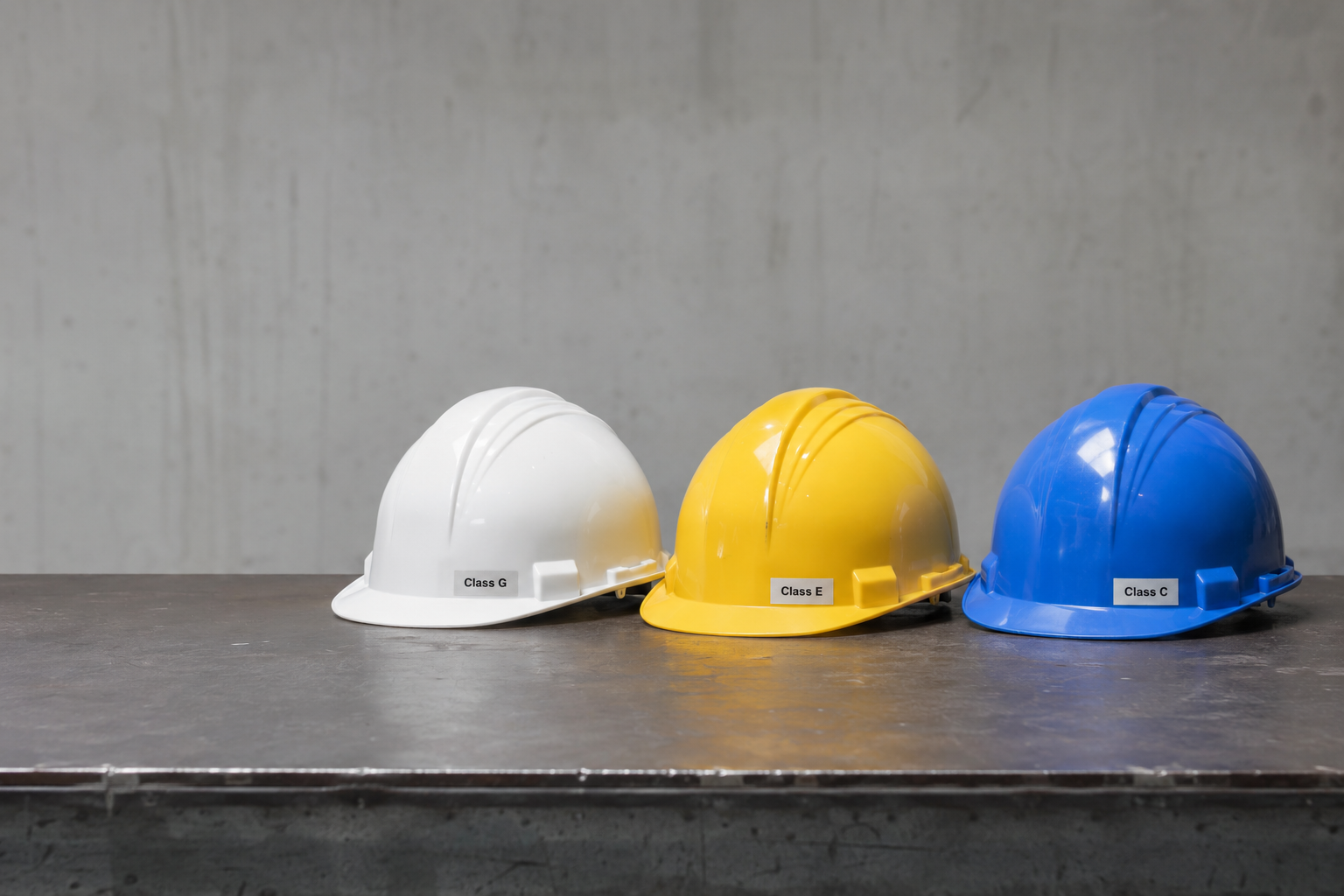
• Class G provides limited electrical protection and is proof tested at 2,200 volts.
• Class E provides higher electrical protection and is proof tested at 20,000 volts.
• Class C provides no electrical protection.
• Type I or Type II describes impact coverage; class describes electrical performance.
• Always confirm the marking inside the helmet and follow the manufacturer’s instructions.
CLASS AND TYPE ANSWER DIFFERENT QUESTIONS
A hard hat label may contain both a type and a class because the two ratings describe different protective functions. Type I head protection is designed for impacts to the top of the head. Type II is designed for impacts to the top and sides. The class—G, E or C—addresses electrical performance. A Type II helmet is not automatically electrically rated, and a Class E helmet is not automatically Type II.
This distinction matters when purchasing teams standardize head protection. Ordering by shell style, color or “heavy duty” language can miss the actual hazard. Start with the employer’s PPE hazard assessment, then verify the type, class, fit and accessory compatibility printed in the helmet or manufacturer documentation.
CLASS G: GENERAL
Class G hard hats are designed to reduce exposure to low-voltage conductors and are proof tested at 2,200 volts. They are a common general-purpose option where impact hazards exist and limited electrical protection is appropriate. “General” does not mean suitable for every task; it indicates a defined electrical test level under the applicable standard.
A Class G rating should not be treated as permission to contact energized equipment. Electrical safety depends on de-energization, safe approach distances, qualified-worker practices and other controls. The helmet is one layer selected for the assessed exposure.
CLASS E: ELECTRICAL
Class E hard hats are designed to reduce exposure to higher-voltage conductors and are proof tested at 20,000 volts. OSHA specifically requires a protective helmet designed to reduce electrical shock hazard when an affected employee works near exposed electrical conductors that could contact the head. Class E is often considered where electrical contact is a credible head hazard.
The test voltage is not a safe working voltage and does not make the wearer insulated from all electrical hazards. Condition, cleanliness, moisture, accessories and modifications can affect performance. Follow the helmet manufacturer’s instructions and the facility’s electrical-safety program.
CLASS C: CONDUCTIVE
Class C hard hats provide impact protection but no electrical protection. Some vented helmets fall into this category because openings or materials prevent an electrical rating. Class C can be appropriate where heat management or ventilation is important and electrical exposure has been ruled out through the hazard assessment.
Do not issue Class C helmets in areas where exposed electrical conductors could contact the head. A worker may move between tasks during a shift, so selection should account for the full work area—not just the primary assignment.
|
CLASS |
ELECTRICAL PERFORMANCE |
PRACTICAL FIT |
|
G • General |
Limited protection; proof tested at 2,200 V |
General industrial work with low-voltage exposure considered |
|
E • Electrical |
Higher protection; proof tested at 20,000 V |
Work near exposed conductors when electrical head protection is required |
|
C • Conductive |
No electrical protection |
Impact-only environments with electrical exposure ruled out |
⚠ COMMON MISTAKE
Problem: A buyer assumes every nonmetal hard hat protects against electricity.
↓ Why it happens: Shell material looks insulating and the class label is overlooked.
↓ Better approach: Check the permanent manufacturer markings for the exact class and confirm it matches the hazard assessment.
SELECTING FOR MIXED WORK ENVIRONMENTS
Many employees do not remain in one controlled area. Maintenance technicians, contractors and supervisors may move from production floors to electrical rooms, rooftops or loading areas during the same shift. Map the highest credible exposure along the full route and decide whether one standardized helmet can cover it or whether task-specific head protection is necessary. Standardization can simplify training and inventory, but only when the selected helmet remains appropriate for every included exposure.
Also consider features that can change the class decision. Vents may improve comfort but are commonly associated with Class C helmets, so they require careful review around electrical hazards. Metal accessories, unauthorized lights, face-shield carriers and hearing-protection adapters can affect compatibility. Choose the helmet and accessories as a tested system, and keep manufacturer documentation available for purchasing and inspection teams.
ℹ DID YOU KNOW?
A higher electrical class does not eliminate the need for electrical work practices. The helmet rating supplements de-energization, approach boundaries, insulation and training; it does not replace them.
HOW TO READ THE MARKING
✓ Locate the manufacturer name or identifying mark.
✓ Confirm compliance with the applicable ANSI/ISEA standard referenced by OSHA or equivalent protection.
✓ Find the impact Type I or Type II designation.
✓ Find the electrical Class G, E or C designation.
✓ Review reverse-wearing, temperature and accessory markings when those features matter.
✓ Match replacement suspensions and accessories to the manufacturer’s approved system.
KEY TAKEAWAY
Class G, E and C describe electrical performance. Choose the class from the electrical hazard, then separately select impact type, fit and compatible accessories. Never infer the class from appearance alone.
CONCLUSION
A clear selection process prevents class letters from becoming meaningless purchasing codes. Document the hazard, identify the required electrical performance, verify the helmet marking and train workers on the limits of the protection. Reassess the choice when jobs, locations or energized systems change. Regulatory references: OSHA 29 CFR 1910.132 and 1910.135; 29 CFR 1926.95 and 1926.100; OSHA Head Protection: Safety Helmets in the Workplace. Confirm site-specific obligations with qualified safety personnel.
Explore Hard Hats
Share:
7 Signs a Hard Hat Is No Longer Safe to Use
Loading Dock Safety Markings: What Areas Should Be Identified?