
|
✓ THE 30-SECOND VERSION · C-fold: familiar, simple stacked sheets; users may pull more than one or reach into the dispenser. · Multifold: interleaved sheets usually present the next towel for more controlled one-at-a-time access. · Multifold often offers better dispensing control, but neither format is universal. · Measure folded width, depth and dispenser capacity before changing formats. |
THE FOLD PATTERN CHANGES THE DISPENSING BEHAVIOR
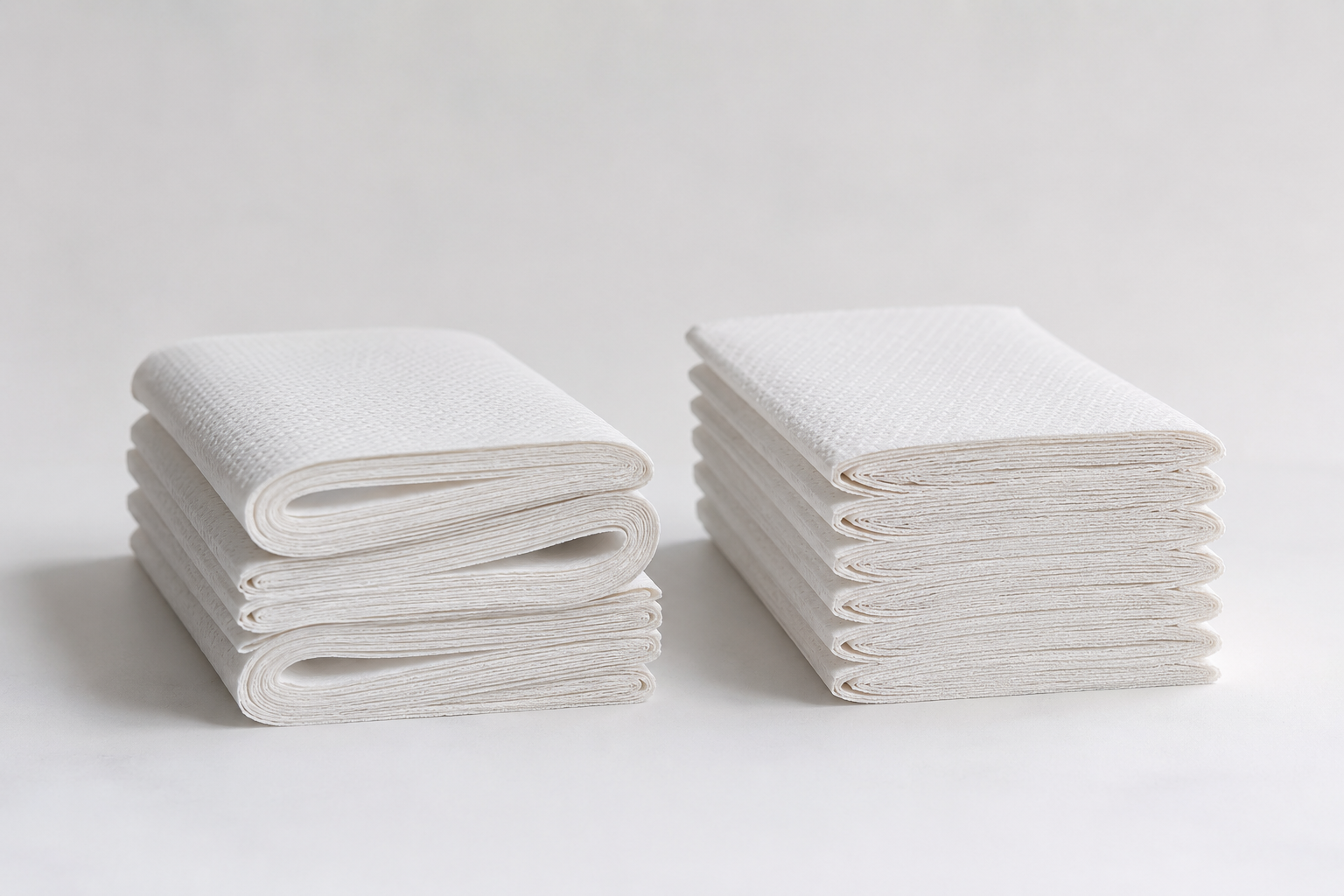
A C-fold towel has both sides folded inward, creating a profile that resembles the letter C when viewed from the end. The towels are stacked, but they are not normally interlocked in a way that consistently pulls the next sheet into position. Users often grasp the exposed underside of the bottom towel through the dispenser opening.
A multifold towel—often called an M-fold or Z-fold towel—is folded and stacked so adjacent sheets overlap. Pulling the exposed towel draws part of the next towel through the slot. This “presented sheet” makes the next towel easier to take and can reduce contact with the dispenser opening or the rest of the stack.
QUICK COMPARISON
|
Feature |
C-fold |
Multifold |
|
Stack relationship |
Separate folded sheets |
Interleaved sheets |
|
Next towel presentation |
Usually remains inside dispenser |
Usually presents through opening |
|
Dispensing control |
More dependent on user grip and stack pressure |
Often better one-at-a-time control |
|
Overfilling sensitivity |
Can bind or dispense in clumps |
Can disrupt interleaving and increase tearing |
|
Typical advantage |
Simple, familiar format |
Convenient access and potential waste reduction |
|
Compatibility need |
Correct folded dimensions and slot design |
Correct dimensions, fold orientation and stack loading |
WHERE MULTIFOLD USUALLY HAS THE EDGE
One-at-a-time presentation
When a compatible multifold towel is loaded correctly, the user can grasp the presented sheet instead of reaching into the opening. This makes the dispensing motion more predictable. It can also reduce the tendency to pull a handful of towels, especially in restrooms where users move quickly and do not carefully separate sheets.
Waste control
Interleaving does not guarantee low consumption, but it supports portion control by presenting one towel at a time. Actual waste still depends on absorbency, open sheet size and how many sheets are needed to dry hands. A thin towel that requires three sheets may cost more per use than a stronger towel with a higher case price.
User access
A consistently presented towel is easier to grasp and helps keep the remaining stack inside the cabinet. This can improve the appearance of the restroom and reduce towels dropped on counters or floors. The advantage disappears if the stack is loaded backward, compressed or mixed with a different fold pattern.
|
💡 QUICK TIP When testing folded towels, count the average number of sheets taken per use and note how often the next sheet fails to present. These observations are more useful than comparing case count alone. |
WHEN C-FOLD CAN STILL BE A PRACTICAL CHOICE
C-fold towels remain useful in facilities with existing dispensers designed for their dimensions, predictable traffic and established purchasing standards. If the current combination dispenses cleanly, stays stocked and produces acceptable usage, changing formats may not create enough operational benefit to justify replacing dispensers or retraining staff.
C-fold can also provide flexibility in certain open-bottom universal cabinets, but “universal” does not mean every product performs equally well. Stack pressure, towel depth and dispensing-slot geometry influence whether users receive one towel or several.
CHOOSE BY OPERATING CONDITIONS
|
HIGH-TRAFFIC RESTROOM Multifold is often the stronger starting point because presented sheets support fast, controlled access. |
EXISTING C-FOLD STANDARD Keep C-fold if the installed system performs well and conversion savings do not justify new hardware. |
|
WASTE-REDUCTION PROJECT Trial multifold and measure sheets per use, dropped towels and refill frequency before and after. |
MIXED DISPENSER SITE Standardize only after mapping each cabinet’s folded dimensions and approved formats. |
COMPATIBILITY COMES BEFORE PREFERENCE
Fold names are categories, not exact dimensions. One manufacturer’s multifold towel may be wider, deeper or thicker than another’s. A stack that is too wide can bind against the cabinet. A stack that is too deep may drag at the opening. An overfilled cabinet compresses the towels, increasing the force needed to pull the first sheets.
· ✓ Identify the dispenser manufacturer and model.
· ✓ Confirm the approved fold type or refill family.
· ✓ Measure folded width and depth—not only the open sheet size.
· ✓ Check maximum stack height and avoid compressing the refill.
· ✓ Load the towels in the indicated direction and test at least 20 pulls.
· ✓ Do not mix C-fold and multifold towels in the same stack.
|
ⓘ DID YOU KNOW? The words “multifold,” “M-fold” and “Z-fold” are often used broadly in purchasing conversations. Always rely on the product’s actual folded dimensions and the dispenser specification rather than the name alone. |
HOW TO COMPARE TOTAL COST
Start with case cost, then calculate usable sheets per case and realistic sheets per hand dry. Add refill labor, dispenser maintenance and the value of towels discarded without use. If a conversion requires new dispensers, include hardware and installation in the payback calculation. A short pilot in representative restrooms will produce a more credible estimate than a spreadsheet based only on manufacturer sheet counts.
For a fair trial, use comparable traffic periods and keep cleaning schedules consistent. Record cases consumed, dispenser outages, user complaints and loose towels found around the sink. The best format is the one that delivers reliable drying with the least combined product waste and service effort.
|
⚠ COMMON MISTAKE Problem: switching from C-fold to multifold without checking the cabinet. ↓ Why it happens: both products are categorized as folded towels. ↓ Better approach: confirm the exact fold, folded dimensions, slot design and stack capacity, then pilot the refill in every dispenser model. |
CONCLUSION: MULTIFOLD OFTEN CONTROLS BETTER—BUT FIT DECIDES
Multifold generally offers the stronger dispensing experience because interleaving presents the next sheet and supports one-at-a-time access. C-fold remains sound when the installed system performs reliably and conversion costs outweigh likely savings. Confirm compatibility, test real consumption and include maintenance labor; a well-matched C-fold system will outperform a poorly matched multifold refill.
|
✓ KEY TAKEAWAY Multifold usually provides better towel presentation and waste control. C-fold remains viable in compatible systems. Dimensions, loading and measured cost per use should decide. |
Explore Paper Towels
Share:
Direct Thermal vs. Thermal Transfer Labels: What’s the Difference?
How to Prevent Paper Towel and Dispenser Compatibility Problems