
|
THE 30-SECOND VERSION ✓ Use direct thermal for short-life applications such as outbound shipping labels, receipts, and temporary identification. ✓ Use thermal transfer when the label must remain readable for months or years or endure demanding conditions. ✓ Confirm the printer’s print method before ordering; a thermal transfer label will not create an image in direct thermal mode without a ribbon. ✓ Match the label material, adhesive, and—when applicable—ribbon to the actual surface and environment. |
THE DIFFERENCE STARTS WITH HOW THE IMAGE IS CREATED
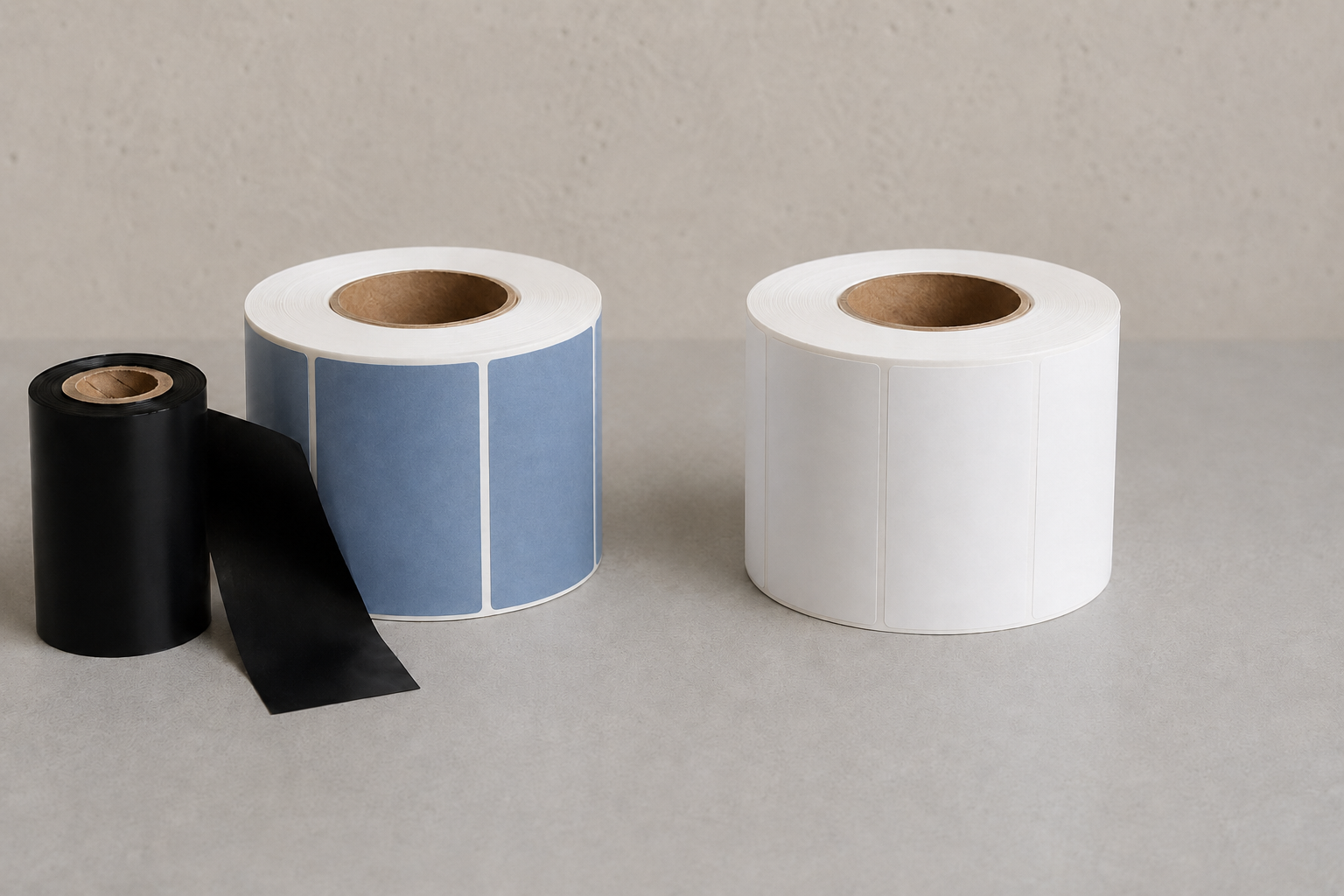
Both methods use a thermal printhead, but the heat reaches the label differently. Direct thermal media contains a heat-sensitive coating that darkens where the printhead applies heat. Thermal transfer printing heats a ribbon, transferring its ink onto the label surface.
That distinction affects more than supply ordering. It changes how long the printed barcode or text can remain readable, what environmental exposure it can tolerate, and how many consumables an operator must manage.
|
Decision factor |
Direct thermal |
Thermal transfer |
|
Ribbon required |
No |
Yes |
|
Best lifespan |
Short-term or temporary |
Long-term or durable |
|
Typical uses |
Shipping, receipts, visitor IDs |
Assets, inventory, product IDs |
|
Heat/light resistance |
More sensitive |
Generally stronger with matched media |
|
Operating simplicity |
Fewer supplies to load |
Ribbon and media must be matched |
|
Material range |
Primarily heat-sensitive media |
Broad paper and synthetic options |
WHEN DIRECT THERMAL IS THE BETTER FIT
Direct thermal is efficient when the label only needs to work through a short operational cycle. An outbound shipping label, for example, usually needs to remain readable from packing through final delivery—not for years afterward.
Because there is no ribbon, operators have one fewer supply to stock, load, and troubleshoot. That can simplify busy packing stations and reduce changeover steps. Direct thermal printing also produces sharp barcodes when the printer is calibrated and the media is compatible.
Best-fit conditions
1. The label’s useful life is measured in days, weeks, or a limited number of months.
2. The label will remain indoors and away from sustained sunlight, high heat, and heavy abrasion.
3. Fast loading and a simple consumables process matter more than long-term image stability.
4. The application includes shipping, tickets, receipts, temporary bins, or short-term identification.
|
☀ DID YOU KNOW? Direct thermal media remains chemically active after printing. Extended exposure to heat or strong light can darken the label and eventually reduce barcode readability. |
WHEN THERMAL TRANSFER IS THE BETTER FIT
Thermal transfer is designed for applications where the printed image must remain stable or withstand a tougher environment. The ribbon creates a durable image on compatible paper or synthetic media, expanding the options for long-term inventory, asset identification, product labeling, cold storage, and industrial tracking.
The added durability is not automatic. A wax, wax-resin, or resin ribbon must be compatible with the label face stock and the exposure the label will face. An incorrect combination may produce weak printing, smearing, or ribbon-related printer problems.
Best-fit conditions
1. The barcode or text must remain readable for months or years.
2. The label may encounter moisture, friction, chemicals, temperature changes, or outdoor exposure.
3. The job requires a synthetic label material or a more permanent identification method.
4. The operation can manage both label and ribbon inventory at the printing station.
|
⚠ COMMON MISTAKE Problem: ordering labels based only on size. ↓ Why it happens: DT and TT labels can look nearly identical before printing. ↓ Better approach: verify the printer model, selected print mode, and ribbon requirement before confirming the label specification. |
A PRACTICAL FOUR-QUESTION DECISION TEST
1. How long must the image remain readable? Short life points toward direct thermal; long life favors thermal transfer.
2.What will the label encounter? Heat, sunlight, moisture, chemicals, and abrasion increase the need for durable media and printing.
3.What printer is installed? Confirm that it supports the intended print method and the required ribbon configuration.
4.What surface receives the label? Corrugated boxes, plastics, metals, and cold surfaces may require different adhesives and face stocks.
CONCLUSION: CHOOSE FOR THE LABEL’S ENTIRE WORKING LIFE
The right choice is determined by the job the label must complete. Direct thermal is often the most practical option for temporary, controlled applications because it eliminates ribbon handling. Thermal transfer earns its extra supply step when long-term readability and environmental resistance are essential.
Before purchasing, document the print method, label size, core or fanfold format, adhesive, face stock, and exposure conditions. That short specification prevents mismatched supplies, avoids printer downtime, and makes repeat ordering far more reliable.
|
KEY TAKEAWAY Choose direct thermal for simplicity and short-life use. Choose thermal transfer for durability and long-term identification. In either case, compatibility among the printer, media, ribbon, adhesive, and environment matters more than the label’s dimensions alone. |
Explore Labels
Share:
How to Choose the Right Label Size, Core Size, and Roll Configuration
C-Fold vs. Multifold Paper Towels: What’s the Difference?