
|
✓ THE 30-SECOND VERSION · Choose center-pull for compact, task-based locations where fast access and simple loading matter. · Choose hardwound for higher-traffic restrooms where capacity and portion control are priorities. · Compare cost per hand dry, not roll price alone; sheet length, absorbency and double-pulling change actual usage. · Confirm roll width, diameter, core and dispensing method before ordering refills. |
HOW THE TWO SYSTEMS WORK
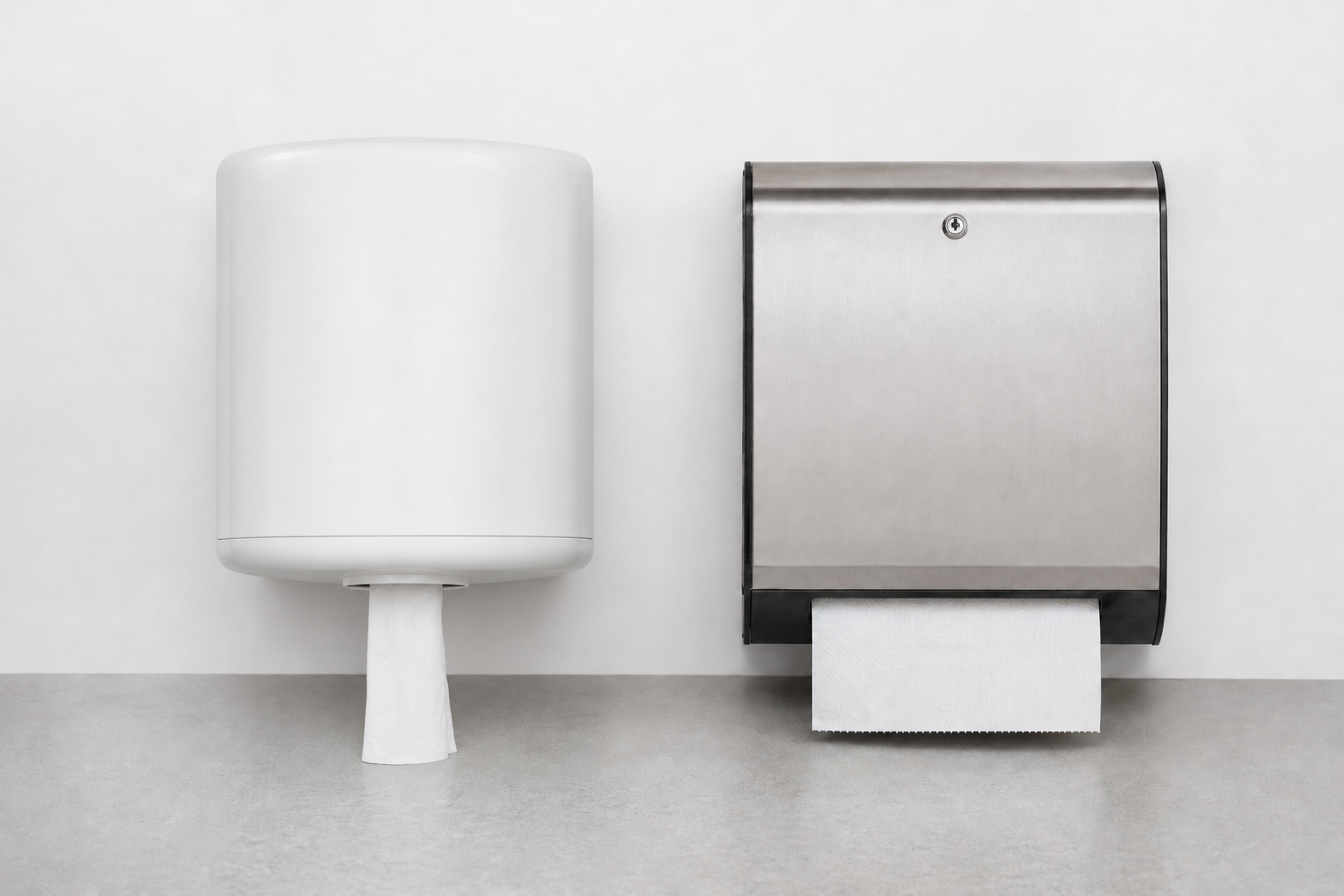
Center-pull towels dispense from the middle of a perforated roll. The user pulls the exposed sheet downward through a restricted opening, separating one towel at a time when the roll, perforations and dispenser are properly matched. The compact format works well at wash stations, food-prep areas, maintenance rooms and other point-of-use locations.
Hardwound towels—also called roll towels—feed from the outside of a tightly wound roll. A manual lever, mechanical auto-cut mechanism or electronic sensor advances and cuts a measured length. Because the roll can carry more usable towel in a controlled dispensing format, hardwound systems are common in public and employee restrooms.
SIDE-BY-SIDE COMPARISON
|
Decision factor |
Center-pull |
Hardwound |
|
Best traffic level |
Low to moderate; task-based use |
Moderate to high; repeated hand drying |
|
Capacity |
Typically lower; compact footprint |
Typically higher; longer service intervals |
|
Dispensing control |
Depends on perforation and pull technique |
Measured cut length or controlled advance |
|
Installation |
Wall-mounted or portable options |
Usually wall-mounted; may require batteries |
|
Maintenance |
Simple loading; opening may need clearing |
More components; fewer roll changes |
|
Common risk |
Tearing inside the dispenser or pulling multiple sheets |
Jams, sensor issues or incorrect roll dimensions |
THE FACTORS THAT MATTER MOST
1. Traffic and refill frequency
A dispenser that works well in a small breakroom can create constant refill work in a busy restroom. Estimate daily users, peak periods and how often staff can inspect the area. Hardwound capacity is valuable when service windows are limited. Center-pull may be more efficient when towels are needed at several small work points and compact dispensers are easier to place.
2. Waste and cost per use
Roll price is an incomplete comparison. A less expensive refill can cost more if users pull two sheets, discard torn pieces or take an unnecessarily long towel. Evaluate the delivered sheet length, absorbency, perforation consistency and average towels used per hand dry. Controlled hardwound dispensing often reduces overuse, but a well-matched center-pull system can also dispense reliably one sheet at a time.
3. Hygiene and touch points
Both systems can support hygienic dispensing when users touch only the towel they take. A center-pull opening should release sheets cleanly without requiring a hand inside the dispenser. Manual hardwound dispensers add a lever touch point; mechanical touch-free and sensor models reduce contact with the dispenser, though they introduce additional components to maintain.
4. Reliability and maintenance
Center-pull dispensers have few moving parts, but incorrect threading, weak perforations or an overfilled chamber can cause tearing. Hardwound dispensers can reduce refill trips, yet cutting mechanisms, feed rollers and sensors must remain clean and correctly adjusted. Reliability depends as much on refill compatibility as on the basic system type.
5. Placement and user behavior
Placement can change consumption as much as the dispenser. A towel that is visible and easy to reach encourages normal one-handed use; an awkwardly mounted unit can lead users to tug harder or take extra sheets. Consider reach range, splash exposure, clearance for opening the cover and nearby waste receptacles. The system should be convenient for users and practical for staff to refill without moving equipment or blocking the area.
|
💡 QUICK TIP Test one full case in the actual dispenser before converting an entire facility. Track refill frequency, complaints, torn towels and case usage for at least two normal service cycles. |
BEST-FIT SCENARIOS
|
CENTER-PULL: WORK CELLS A compact dispenser keeps towels close to the task and can be moved or mounted where splashes and routine cleanup occur. |
HARDWOUND: PUBLIC RESTROOMS Higher capacity and measured dispensing help control service demands during steady or unpredictable traffic. |
|
CENTER-PULL: FOOD PREP Simple access can work well at designated stations when the towel and dispenser meet the facility’s sanitation procedures. |
HARDWOUND: SCHOOLS & VENUES Longer rolls and controlled delivery reduce the chance of empty dispensers during short, heavy-use periods. |
A SIMPLE SELECTION CHECKLIST
· ✓ Measure available wall or counter space and confirm mounting requirements.
· ✓ Estimate users per day, peak traffic and acceptable refill frequency.
· ✓ Compare roll width, roll diameter, core dimensions and sheet format.
· ✓ Decide whether batteries, sensors or manual levers fit the maintenance plan.
· ✓ Calculate cost per use with realistic sheets per hand dry.
· ✓ Run an in-dispenser trial before standardizing across locations.
|
⚠ COMMON MISTAKE Problem: choosing the lowest case price. ↓ Why it happens: refill price is easy to compare, while waste and labor are less visible. ↓ Better approach: compare total case yield, average towels per use, refill labor and dispenser reliability. |
CONCLUSION: MATCH THE SYSTEM TO THE WORK
Neither format is automatically better everywhere. Center-pull is often the practical choice for compact, task-based locations that benefit from simple loading and quick access. Hardwound is usually stronger in busy restrooms where higher capacity and controlled dispensing reduce service pressure.
The best decision comes from matching traffic, placement, maintenance resources and refill dimensions—not from comparing roll prices in isolation. A short trial with real users will reveal the cost and reliability differences that product specifications cannot show on their own.
|
✓ KEY TAKEAWAY Use center-pull for simplicity and point-of-use access; use hardwound for capacity and tighter portion control. In either case, verify compatibility and measure actual consumption before a full rollout. |
Explore Paper Towels
Share:
How to Prevent Paper Towel and Dispenser Compatibility Problems
How to Prevent Soap and Sanitizer Dispenser Compatibility Problems