
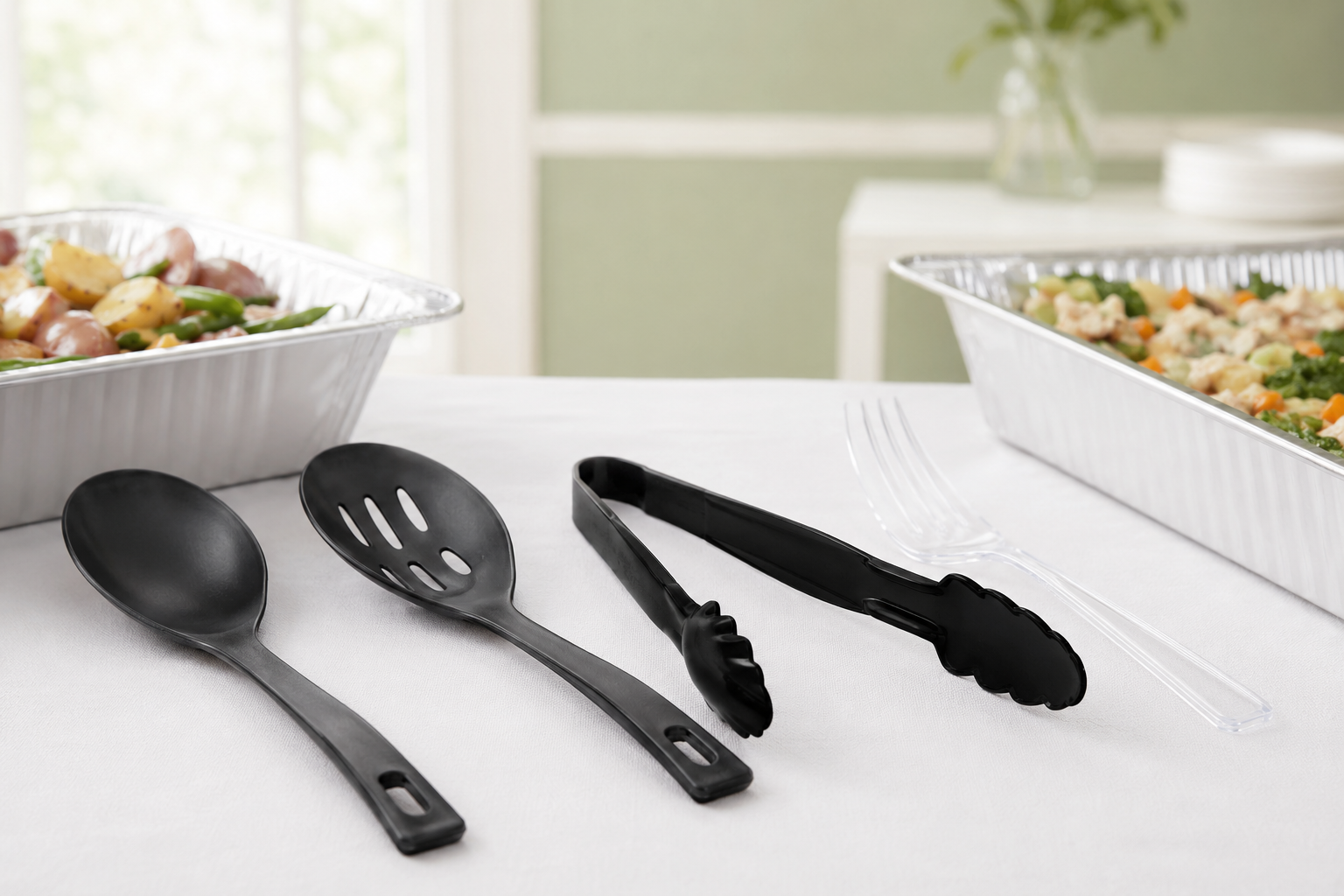
|
THE 30-SECOND VERSION • Match the utensil shape to the food and desired portion. • Choose strength based on food weight and resistance—not event formality alone. • Confirm handle length works with the serving vessel. • Provide dedicated utensils for allergens and every separate dish. • Order backups for dropped, broken, or misplaced utensils. |
BEGIN WITH THE FOOD, NOT THE UTENSIL PACKAGE
Serving utensils affect speed, portion control, presentation, and sanitation. Before choosing a material or style, define what the utensil must pick up, the intended portion, and how guests will reach the food.
MATCH THE UTENSIL TO THE TASK
|
FOOD OR TASK |
BEST STARTING CHOICE |
WHY IT WORKS |
|
Rice, pasta, vegetables |
Solid serving spoon |
Moves a controlled portion and works with most pan shapes. |
|
Foods in liquid or sauce |
Slotted spoon |
Lifts solids while allowing excess liquid to drain. |
|
Gravy, soup, dressing |
Ladle |
Provides a repeatable liquid portion with less dripping. |
|
Rolls, sliced meats, salad |
Serving tongs |
Offers grip without guests touching adjacent food. |
|
Carved or large proteins |
Serving fork or heavy-duty tongs |
Provides more control for dense, irregular portions. |
|
Cake, pie, layered desserts |
Cake or pie server |
Supports the portion from below and protects presentation. |
Food texture changes with temperature and holding time. Test the actual utensil with a full production pan, not an empty container.
CHOOSE THE APPROPRIATE STRENGTH
Lightweight
Lightweight utensils suit soft, low-resistance foods and short events. Avoid them for dense foods or tasks requiring leverage.
Medium weight
Medium-weight utensils balance strength and cost for many salads, pastas, vegetables, and side dishes.
Heavy duty
Heavy-duty utensils suit dense food, long events, and repeated use. Extra rigidity also reduces spills caused by flexing.
|
💡 QUICK TIP The heaviest utensil is not automatically the best value. Use heavy-duty pieces where leverage and repeated use demand them, then use medium or lightweight options for softer foods. |
CHECK HANDLE LENGTH AND PAN DEPTH
A utensil should reach the food without forcing a guest’s hand over the rim. Deep pans and tall bowls generally need longer handles; shallow trays can use shorter tools. Confirm that the handle rests securely without sliding into the food.
Test the grip with a full portion and while wearing the gloves used during setup and replenishment.
CONTROL PORTIONS WITHOUT SLOWING THE LINE
Utensil capacity shapes the serving size. A larger spoon may speed up service but increase food use and create inconsistent portions. A small utensil can cause guests to take repeated scoops, slowing the line and increasing contact around the pan. Match the utensil to the planned portion, then confirm that the amount looks appropriate on the plate.
|
SERVICE GOAL |
SELECTION SIGNAL |
|
Faster throughput |
Choose a utensil that delivers the intended portion in one controlled motion. |
|
Tighter portion control |
Use a repeatable scoop or ladle size and train servers on the target fill. |
|
Cleaner presentation |
Use tools that support or grip the food without tearing, dripping, or overfilling. |
|
Lower replacement risk |
Increase strength for foods that require force or for long service periods. |
PLAN FOR SANITATION AND ALLERGENS
Every dish needs its own utensil. Shared utensils can transfer food particles, allergens, sauces, and flavors between pans. For allergen-sensitive service, use clearly distinguishable utensils and placement rules, and train staff to replace any utensil that is moved to the wrong dish. Color coding can help, but it does not replace labels, separation, or an established allergen procedure.
• Keep wrapped backups near the service area.
• Replace utensils that fall, become contaminated, or move between foods.
• Use a clean rest that keeps the handle out of the food and the food-contact end off the table.
• Assign staff to inspect utensil placement during buffet checks.
|
⚠ COMMON MISTAKE PROBLEM ↓ WHY IT HAPPENS ↓ BETTER APPROACH |
ESTIMATE THE QUANTITY
Provide one dedicated utensil for every food item and every duplicate pan open at the same time, then add replacements based on event length, guest count, staffing, and distance from storage. Self-service events generally need more immediate backups than staffed buffets.
Keep spoon rests, labels, and clean replacements together near the service area.
FINAL SELECTION CHECKLIST
• Food texture and serving temperature tested.
• Utensil shape matches the food and intended portion.
• Strength supports a full serving without excessive flex.
• Handle length fits the pan, bowl, or platter.
• Material and appearance match the event’s service level.
• Each dish has a dedicated utensil and allergen controls.
• Clean backups and utensil rests are included in the setup plan.
CONCLUSION
Disposable serving utensils should be chosen as operating tools, not generic accessories. Matching shape, strength, capacity, and handle length to each dish improves the guest experience and makes the buffet easier to maintain. A short food test and a planned supply of dedicated backups can prevent the most common service problems before guests arrive.
KEY TAKEAWAY
Choose utensils dish by dish. Match the tool to the food, portion, pan, and service conditions; then provide dedicated, clearly managed backups for uninterrupted service.
Explore Catering Supplies
Share:
Polypropylene vs. Polyester vs. Steel Strapping: Which Is Best?
How to Keep Catered Food Secure During Transportation