
THE 30-SECOND VERSION
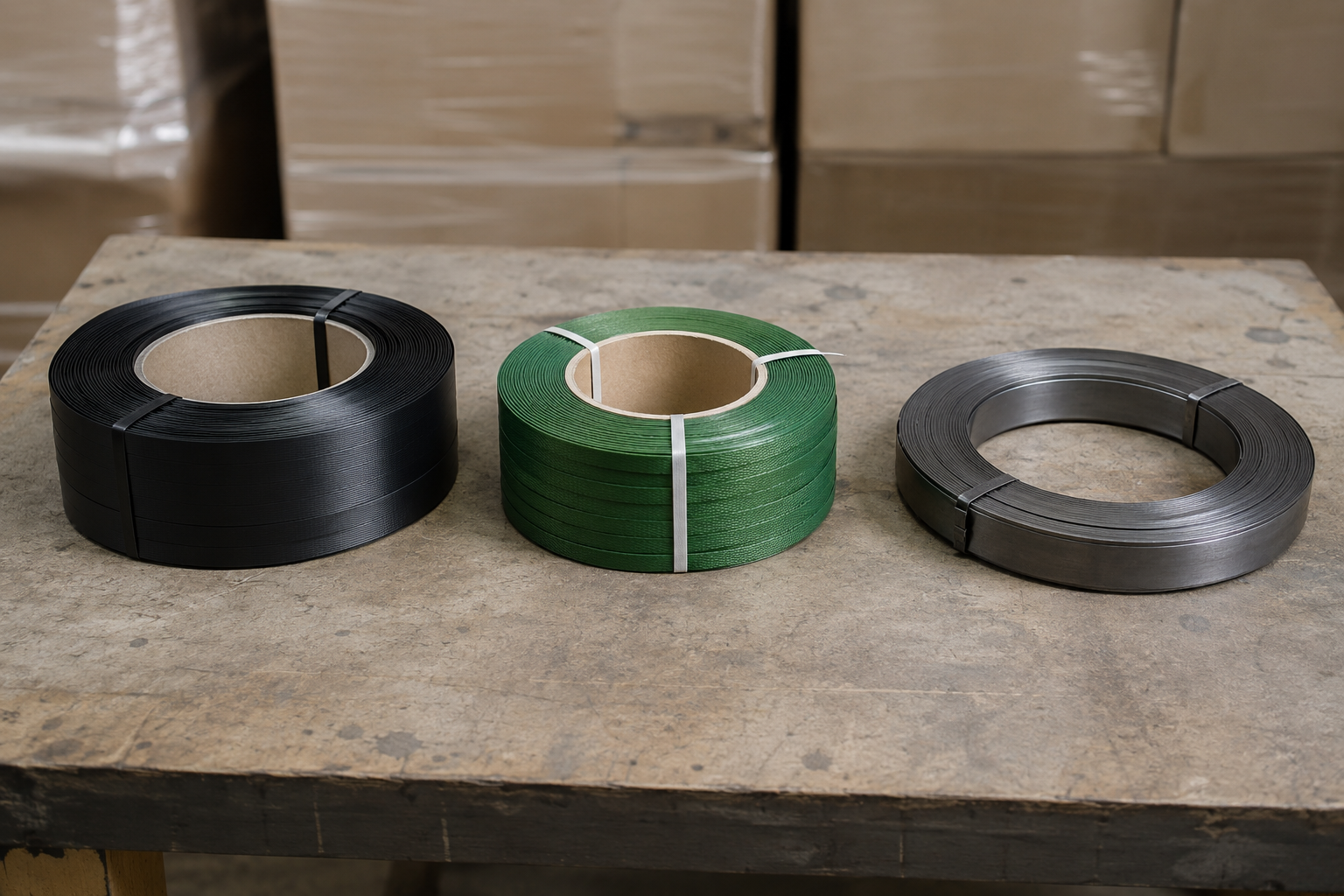
1. Choose polypropylene for cartons, light bundles, and other loads that can compress or settle.
2. Choose polyester for heavier pallet loads that need strong tension retention and some shock absorption.
3. Choose steel for rigid, sharp-edged, high-temperature, or very heavy loads where maximum strength and minimal stretch matter.
4. Confirm the strap, closure, tool, and edge-protection system as one package before ordering.
START WITH THE LOAD—NOT THE MATERIAL NAME
The right strapping keeps a load unitized through lifting, vibration, turns, impacts, and temperature changes. A strap can have impressive break strength and still perform poorly if it loses tension as cartons settle, damages the product, or cannot be applied consistently by the available equipment.
Begin by observing how the load behaves. Is it compressible or rigid? Are the edges sharp? Can the product expand, shrink, or settle? Will it be stored outdoors, exposed to moisture, or handled while warm? The answers narrow the material choice more reliably than load weight alone.
MATERIAL COMPARISON AT A GLANCE
|
Material |
Best fit |
Load behavior |
Watch for |
|
Polypropylene (PP) |
Cartons, light bundles, light-to-medium palletizing |
High elongation and good recovery; adapts to compressible loads |
Can lose retained tension as a load settles; not ideal for high heat or sharp edges |
|
Polyester (PET) |
Heavy pallets, bricks, cans, lumber, stable industrial loads |
Strong tension retention with useful elongation and shock absorption |
Needs compatible PET tools and closures; edge protection may still be required |
|
Steel |
Metal, construction materials, rigid or very heavy loads |
Highest strength and very low elongation |
Sharp edges, recoil, corrosion, and product marking require careful controls |
Polypropylene: economical flexibility
Polypropylene is the usual starting point for light-duty bundling, carton reinforcement, and many general warehouse applications. It is lightweight, moisture-resistant, and easy to handle. Its higher elongation allows it to stretch when a package is compressed or shocked, then recover part of that movement.
That flexibility is also its limitation. If cartons crush or a pallet settles significantly, polypropylene may not maintain the original clamping force. It is best when the load does not demand high sustained tension. Buy Right carries both hand-grade and machine-grade polypropylene, so the application method must be decided along with the material.
Polyester: strong retention with controlled give
Polyester is a practical choice for heavier, stable pallet loads. Compared with polypropylene, it generally provides greater strength and better retained tension. Unlike steel, it can elongate and absorb impacts without permanently deforming as easily. Those characteristics make PET a common option when a load needs firm containment but still experiences normal transportation shock.
Polyester also resists moisture and corrosion and has no sharp steel edge. It is often considered as a steel replacement, but substitution should be tested rather than assumed. Load geometry, strap count, joint efficiency, equipment settings, handling routes, and regulatory or customer requirements all affect the decision.
Steel: maximum strength for demanding loads
Steel provides high tensile strength, low stretch, and excellent retained tension on rigid loads. It is well suited to metal products, heavy construction materials, sharp-edged bundles, high-temperature products, and some round or irregular loads. Regular-duty steel supports many industrial unitizing jobs; high-tensile steel is intended for more severe loads and higher tension requirements.
The tradeoffs are operational. Steel is heavier, can rust if the finish or storage conditions are inadequate, and may damage unprotected product edges. Cut strap can spring outward. Teams need the correct dispenser, tensioner, sealer or sealless tool, cutter, gloves, eye protection, and a controlled removal procedure.
ⓘ DID YOU KNOW?
“Stronger” and “safer for the load” are not synonyms. A very rigid strap can crush a compressible carton, while an overly elastic strap can allow a rigid load to shift. The best material supplies enough containment while accommodating the way the load changes.
BEST-FIT SCENARIOS
Light cartons moving through a distribution center
Start with polypropylene. It is economical, easy to apply, and appropriate when the goal is bundling or light pallet reinforcement. Verify that retained tension remains adequate after the cartons settle.
A dense pallet of brick, cans, or packaged building products
Evaluate polyester. Its strength, tension retention, and shock response often suit stable, heavy loads. Use edge protectors where concentrated strap pressure could damage packaging or the strap.
Metal shapes, sharp-edged bundles, or material strapped while hot
Steel may be necessary because plastic can be cut by edges or affected by heat. Confirm the exact steel grade, dimensions, finish, closure, and tool with the system supplier before use.
A PRACTICAL SELECTION CHECKLIST
1. Document the loaded pallet weight, dimensions, center of gravity, and number of straps.
2. Classify the load as compressible, stable, expanding, settling, sharp-edged, round, or irregular.
3. Record temperature, moisture, UV exposure, storage time, and handling conditions.
4. Check required break strength, retained tension, elongation, and joint efficiency—not break strength alone.
5. Confirm compatibility with the dispenser, tensioner, sealer, buckle, machine, and cutter.
6. Run a controlled transit test and inspect tension, strap position, product damage, and joint condition.
CONCLUSION
Polypropylene, polyester, and steel each solve a different containment problem. Polypropylene brings economical flexibility to lighter loads. Polyester combines strength, retained tension, and shock absorption for many heavier pallets. Steel remains the dependable choice when very high strength, minimal stretch, heat tolerance, or sharp-edge resistance is essential.
A sound decision considers the entire system: load behavior, strap properties, number and placement of straps, edge protection, closure efficiency, application tools, and safe removal. Test the proposed configuration under realistic handling conditions before standardizing it across shipments.
KEY TAKEAWAY
Select the lightest practical system that safely maintains load integrity through the full handling cycle. The correct material is the one that retains adequate containment without damaging the product or creating unnecessary handling risk.
Explore Strapping
Share:
How to Choose Strapping Width, Break Strength, and Grade
How to Choose Disposable Serving Utensils for a Buffet