
|
THE 30-SECOND VERSION • Confirm the equipment opening before choosing a pan. • Use full, half, or fractional pans to control menu variety and refill frequency. • Choose depth by food type—not simply by maximum capacity. • Verify lids, carriers, drain shelves, and inserts against the exact manufacturer specifications. |
START WITH THE EQUIPMENT, NOT THE MENU
A steam table pan only works if it fits the chafer, hot well, carrier, lid, and any accessory used with it. Before comparing capacities, record the inside opening, supported pan sizes, and maximum depth of the equipment. A pan that is nominally “full size” can still create problems when rim profiles, corner shapes, or lid styles differ.
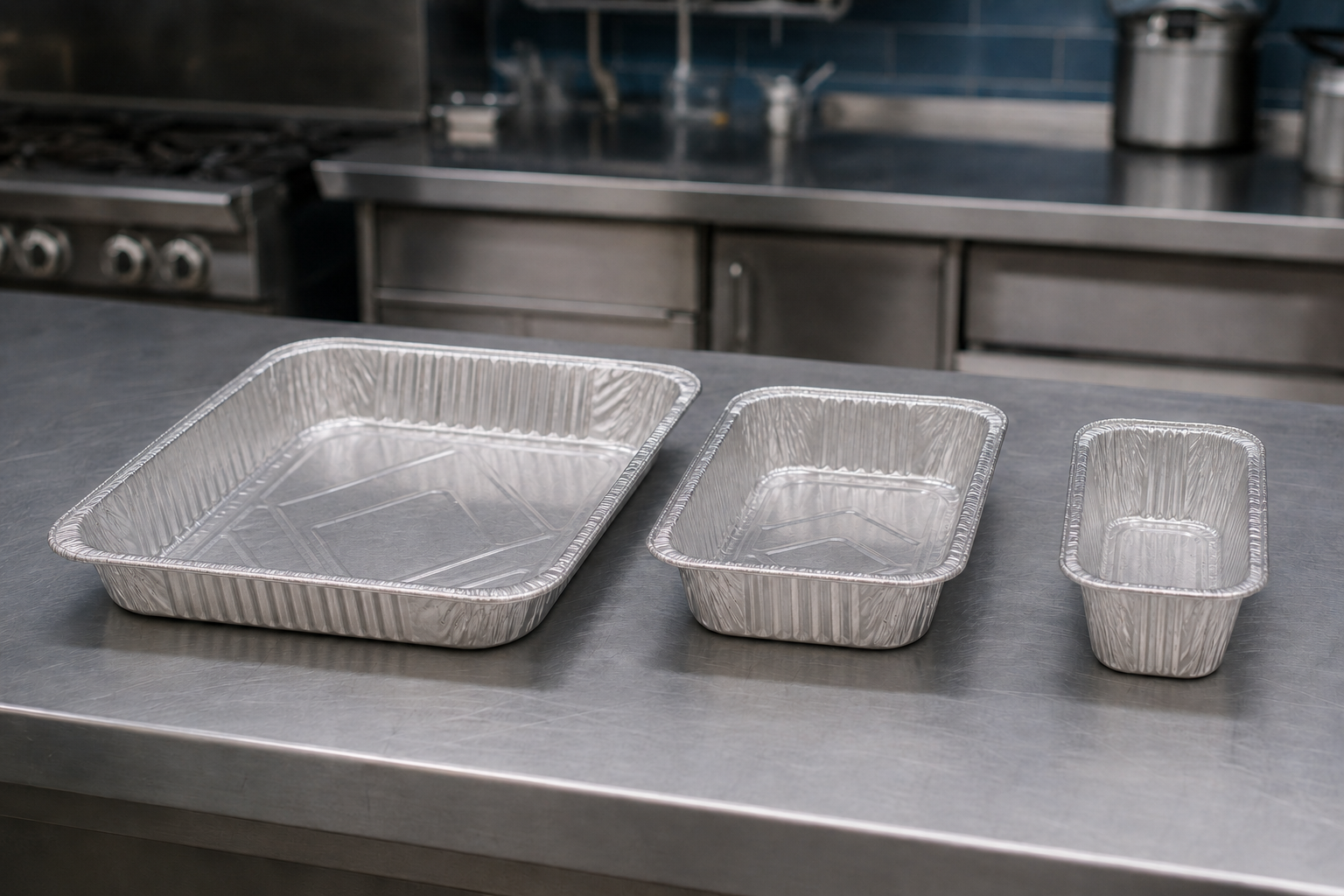
In commercial food service, full-size pans provide the reference footprint. Smaller pans divide that footprint so several menu items can share one well. This modular approach helps caterers add variety without dedicating a full opening to every dish.
UNDERSTAND THE STANDARD FOOTPRINTS
|
PAN SIZE |
APPROX. TOP DIMENSIONS* |
TYPICAL BEST FIT |
|
Full size |
20 3/4 × 12 3/4 in. |
High-volume entrées, pasta, rice, or one primary item |
|
Half size |
12 3/4 × 10 3/8 in. |
Two-item service, sides, proteins, or smaller batches |
|
Third size |
12 3/4 × 6 7/8 in. |
Three menu choices, toppings, sauces, or controlled portions |
|
Quarter size |
10 3/8 × 6 3/8 in. |
Small sides, garnishes, condiments, or low-volume items |
*Dimensions are common industry references. Always verify the product and equipment specifications before ordering.
A full-size opening can generally be configured as one full pan, two half pans, or three third pans. The practical choice depends on the menu. One large pan reduces changeovers for a popular entrée; fractional pans let staff offer more foods while keeping smaller amounts on the line.
CHOOSE A DEPTH THAT SUPPORTS THE FOOD
Shallow pans: approximately 2½ inches
Shallow pans keep food visible and easy to reach. They are useful for roasted vegetables, cut proteins, baked items, or foods that should be refreshed in smaller batches. Less product weight also makes them easier to carry and replace during service.
Medium pans: approximately 4 inches
Medium pans provide a balanced option for most buffet foods. They hold a meaningful volume without making the bottom difficult to reach. They are often a practical default for pasta, rice, vegetables, and moderate-volume entrées.
Deep pans: approximately 6 inches
Deep pans reduce refill frequency, but more capacity is not always better. A filled pan can be heavy, harder to transport, and slower to serve from. Deep pans make the most sense for high-volume items, soups, sauces, or foods that remain consistent throughout the service window.
|
💡 QUICK TIP Estimate the filled weight—not just the pan capacity. If one employee cannot lift and place the pan safely, use a shallower pan or split the food into smaller batches. |
MATCH THE PAN TO THE SERVICE PLAN
|
SERVICE QUESTION |
IF YES |
BETTER DIRECTION |
|
Will one item account for most servings? |
High demand |
Use a full or deeper pan to limit changeovers. |
|
Do guests need several choices? |
Menu variety |
Use half or third pans in one full-size opening. |
|
Does quality decline during long holding? |
Quality sensitive |
Use shallower pans and replenish more frequently. |
|
Will pans travel while filled? |
Off-site service |
Favor manageable weights, secure lids, and carrier fit. |
|
Will staff portion from the pan? |
Portion control |
Choose a depth that keeps the food easy to see and reach. |
Food behavior matters as much as volume. Crisp foods can soften when held in a deep, crowded pan. Layered foods may lose structure when staff must reach far into the pan. Sauces and braised dishes tolerate depth better, provided they are held and monitored according to the operation’s food-safety procedures.
CHECK MATERIAL, GAUGE, AND ACCESSORIES
Disposable aluminum pans are convenient for off-site events and cleanup. Standard-duty pans work for lighter foods and short handling cycles; heavy-duty pans add rigidity for dense entrées, liquids, or repeated movement. When a pan will be carried while full, a sheet pan, rigid carrier, or other secondary support can reduce flexing.
• Confirm whether the lid is flat, domed, or foil and whether it matches the rim.
• Check the carrier’s maximum pan depth and whether the lid adds height.
• Verify that drain shelves, colanders, and divider inserts fit the pan series.
• Standardize a small set of sizes when possible to simplify purchasing and storage.
|
⚠ COMMON MISTAKE PROBLEM ↓ WHY IT HAPPENS ↓ BETTER APPROACH |
A FIVE-STEP BUYING CHECK
• Measure the equipment opening and record the supported depth.
• Choose the pan configuration based on menu variety and expected demand.
• Select depth based on food quality, reach, refill frequency, and filled weight.
• Confirm pan strength for the food and number of handling steps.
• Verify every lid, carrier, insert, and replacement item as one compatible system.
CONCLUSION
The right steam table pan is not automatically the largest one available. It is the pan that fits the equipment, holds the appropriate service quantity, protects food quality, and remains manageable for the team. Starting with compatibility and then balancing footprint, depth, and handling needs prevents costly mismatches and makes buffet service easier to control.
|
KEY TAKEAWAY Choose the footprint for menu variety, the depth for food behavior and service volume, and the construction for handling demands. Verify the complete system before ordering. |
Explore Catering Supplies
Share:
How to Keep Catered Food Secure During Transportation
Roll Labels vs. Fanfold Labels: Which Format Is Better?