
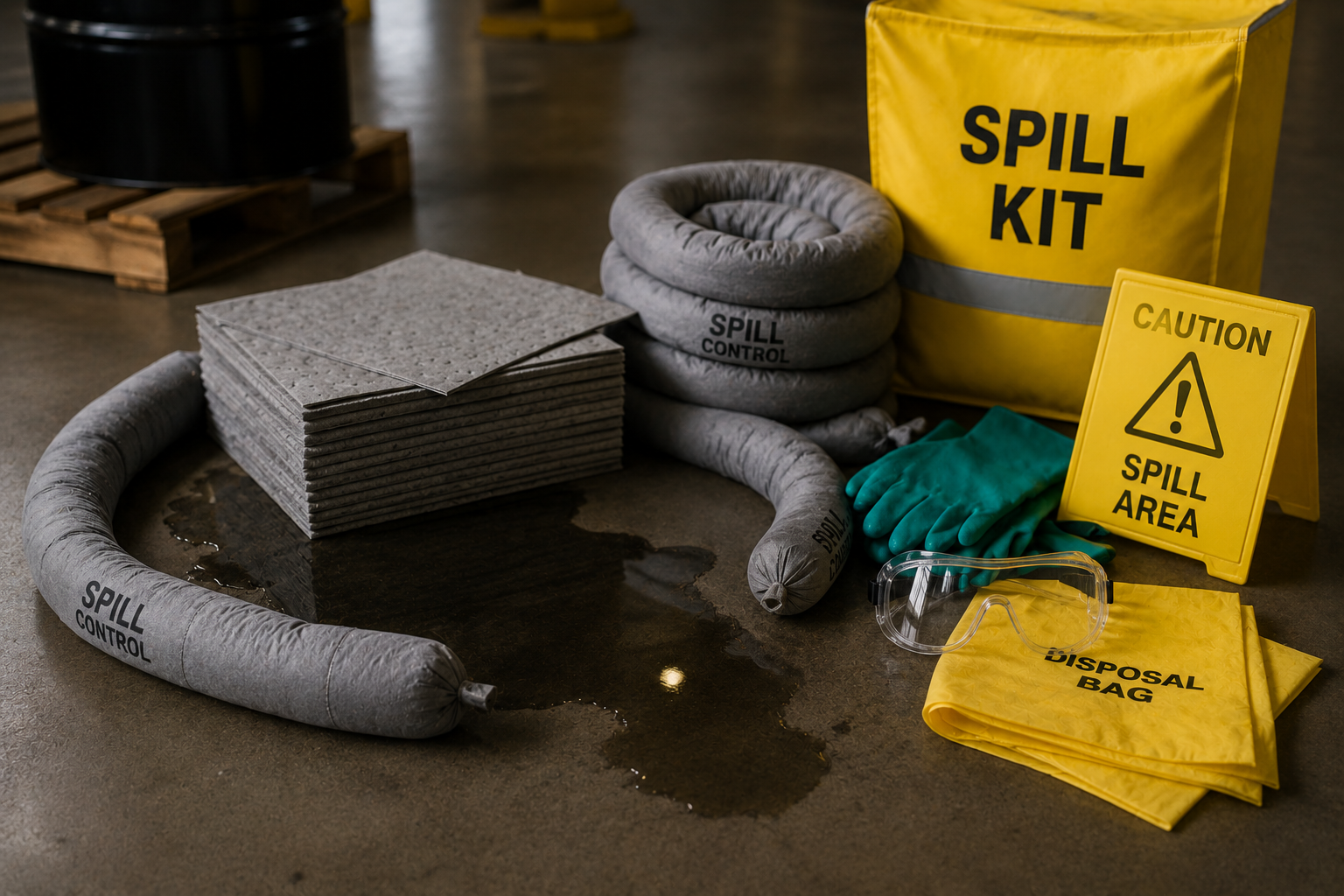
Spill control products come in several formats, and each is designed for a specific purpose. While spill pads, spill socks, spill booms, and spill rolls all help manage liquids, they are not interchangeable. Understanding the strengths and limitations of each can help facilities respond more effectively to spills and leaks.
|
Quick Comparison |
|
|
Spill Pads |
Best for direct absorption and small spills.
|
|
Spill Socks |
Best for containment and preventing spread.
|
|
Spill Booms |
Best for larger-scale containment, especially outdoors. |
|
Spill Rolls |
Best for covering large areas and ongoing leak protection. |
What Are Spill Pads?
Spill pads are flat absorbent sheets designed to absorb liquids directly from floors, equipment surfaces, and work areas. They are commonly used during routine maintenance activities and for cleaning up small to medium spills.
Because they are lightweight and easy to deploy, pads are often the first absorbent product used during spill response. However, they do little to stop a spill from spreading.
What Are Spill Socks?
Spill socks are flexible absorbent tubes designed primarily for containment. They are often placed around the perimeter of a spill to prevent liquids from migrating to surrounding areas.
Their flexibility allows them to conform around machinery, drums, and floor drains. In many spill response situations, socks are deployed first and absorbent pads are used afterward to complete cleanup.
What Are Spill Booms?
Spill booms serve a similar containment function but are generally larger and commonly used outdoors. They are frequently associated with oil spill response and environmental protection applications.
Booms are often used in retention ponds, waterways, industrial sites, and other situations where large-scale containment is required.
What Are Spill Rolls?
Spill rolls provide continuous absorbent coverage and can be cut to virtually any length. They are commonly used along production lines, walkways, maintenance areas, and beneath equipment prone to leaking.
For facilities dealing with recurring drips or ongoing maintenance work, spill rolls often provide a practical and economical solution.
How to Choose the Right Product
If your goal is to absorb liquid directly, pads and rolls are typically the best options. If your primary concern is preventing a spill from spreading, socks or booms may be more appropriate.
In many cases, effective spill response involves using multiple products together. A spill may first be contained with socks and then absorbed using pads or rolls.
Frequently Asked Questions
What is the difference between spill pads and spill socks?
Pads are designed primarily for absorption, while socks are designed primarily for containment.
When should spill booms be used?
Spill booms are commonly used for outdoor containment and environmental spill response applications.
Are spill rolls better than pads?
Not necessarily. Rolls are better for covering large areas, while pads are often better for targeted cleanup tasks.
Explore Spill Control
Share:
Universal, Oil-Only, or Chemical Spill Kits: Which Should You Choose?
How to Choose the Right Absorbent for Your Spill