
|
THE 30-SECOND VERSION |
|
✓ Choose based on material behavior and acceptable edge quality. ✓ Straight edges work best when material tears predictably across a supported line. ✓ Serrated edges help initiate cuts in film, foil and other flexible media. ✓ Thickness, stretch, reinforcement and coating can change performance. ✓ Test the actual production roll before purchasing multiple units. |
|
HOW THE TWO EDGES WORK |
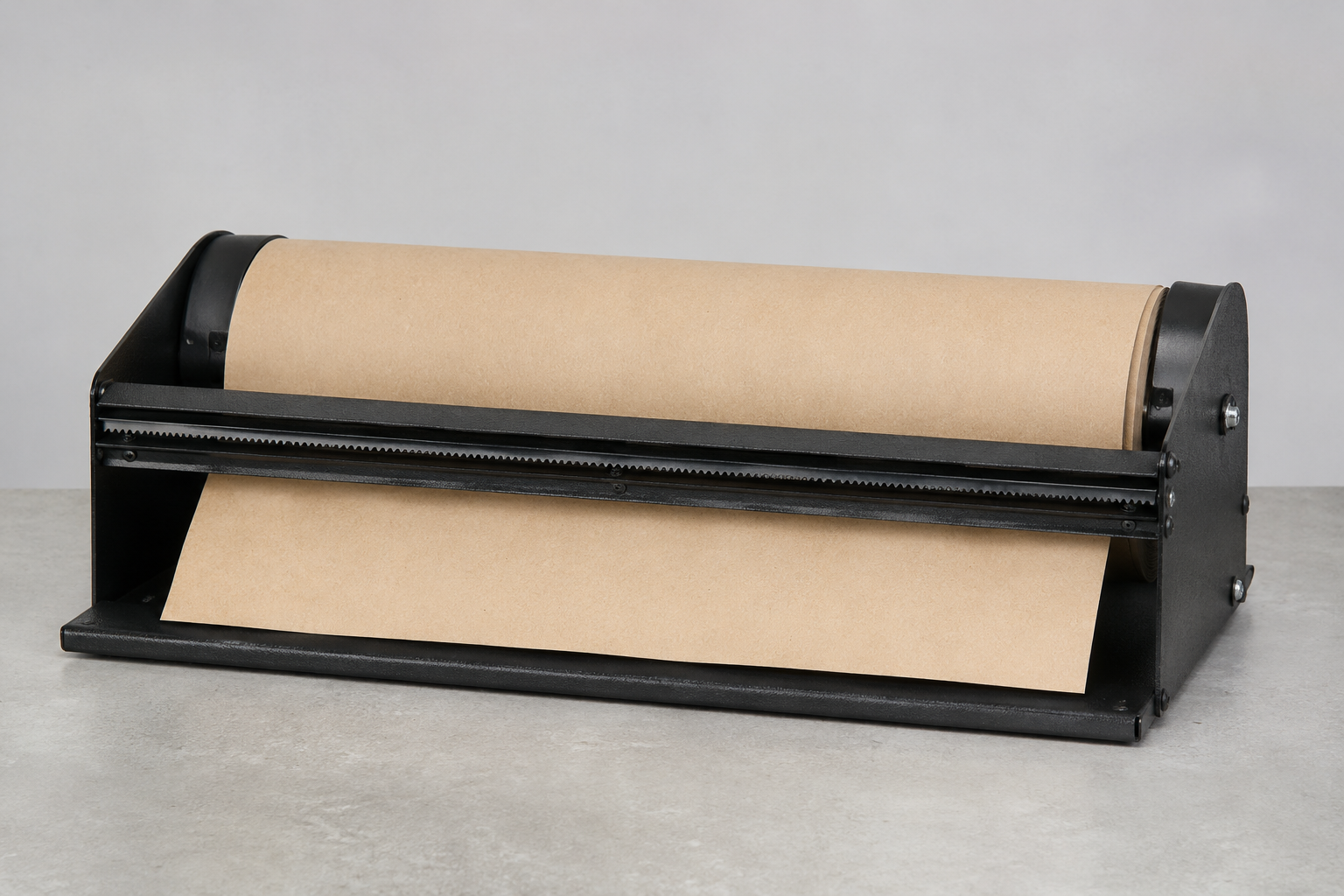
A straight-edge dispenser holds material against a continuous bar so the operator can tear across a stable line. The cut depends partly on the material’s willingness to propagate that tear. Paper commonly behaves well because its fibers separate consistently once tension is distributed across the edge.
A serrated edge concentrates force at a series of points. Those teeth help pierce or start a cut in flexible material that might slide, stretch or resist a smooth bar. The tradeoff is a more visibly toothed edge, which may be acceptable for process materials but undesirable for presentation work.
|
USE MATERIAL BEHAVIOR AS THE DECIDING FACTOR |
Material name alone is not enough. Two films can behave differently because of thickness, stretch, reinforcement or coating. Likewise, light kraft paper and heavy reinforced paper may not cut best on the same edge. Evaluate resistance to tearing, tendency to stretch, surface slickness and the quality required at the finished edge.
|
Material behavior |
Straight edge |
Serrated edge |
|
Tears cleanly under tension |
Strong fit |
Usually unnecessary |
|
Stretches before tearing |
May pull or bunch |
Often better |
|
Slick or difficult to grip |
Can slide |
Teeth help initiate |
|
Visible finished edge matters |
Cleaner appearance |
Test tooth marks |
|
Thick or reinforced |
May require excess force |
May help; verify capacity |
|
💡 QUICK TIP Keep one sample roll or a verified specification sheet beside the equipment-selection record so future substitutions can be checked quickly. |
|
WHERE STRAIGHT EDGES PERFORM WELL |
Straight edges are a practical choice for kraft paper, art paper, wrapping paper and similar roll stock when a fast, reasonably clean tear is sufficient. They are common in classrooms, retail wrapping areas and packing stations because the mechanism is simple and the operator can cut across a broad width.
Results improve when the roll feeds squarely and the operator maintains even tension. A skewed roll or unsupported sheet can create an angled tear that is mistakenly blamed on the cutter.
|
WHERE SERRATED EDGES ADD CONTROL |
Serrated cutters are commonly considered for plastic film, foil, cello and other flexible materials. The teeth provide multiple starting points, reducing the need to pull harder against a smooth edge. This can shorten the motion and make repeated cuts more consistent.
Serrated does not automatically mean heavy-duty. The frame, roll capacity and material path must still be appropriate. Operators should use the designed pulling direction and keep hands away from the cutting edge.
|
RUN A SIMPLE MATERIAL TRIAL |
Load the actual roll and make repeated cuts at typical lengths. Watch whether the material feeds evenly, stretches, tears diagonally or requires excessive force. Inspect the finished edge and repeat the test with different operators. A suitable system should produce consistent results without a special technique known by only one employee.
|
Check |
Pass signal |
Warning signal |
|
Feed |
Smooth and centered |
Drag, telescoping or skew |
|
Cut initiation |
Starts with normal force |
Stretching or repeated pulls |
|
Finished edge |
Acceptable for use |
Excessive tooth marks or ragged tear |
|
Operator motion |
Stable posture |
Twisting, reaching or bracing |
|
LOOK BEYOND THE EDGE |
The cutter is only one part of the system. Confirm roll width, diameter, core compatibility and weight. Review mounting style and replacement components. For foam, bubble or other materials where a square, controlled cut is essential, a razor or rotary shear system may be a better third option than either tear-bar style.
Review the station over a full shift rather than during one demonstration. Changes in roll diameter, pace and operator experience may expose feed or cut problems that do not appear in a single trial.
Maintenance affects the comparison as well. Residue, bent teeth, a damaged bar or loose roll supports can make either edge perform poorly. Establish an inspection interval, replace worn components promptly and avoid improvised sharpening that could change the designed edge geometry. Record recurring failures, because repeated damage may indicate that the cutter is mismatched to the material or production volume rather than simply worn.
|
⚠ COMMON MISTAKE Assuming serrated is always stronger → the edge is chosen without considering roll capacity or finished-edge requirements → evaluate the complete dispenser and test the production material. |
|
CONCLUSION |
A roll dispenser or cutter earns its place by making routine work more controlled, repeatable and practical. A disciplined selection process reduces fit surprises, protects workspace and gives operators equipment that works with the material rather than against it.
|
✓ KEY TAKEAWAY Use a straight edge for materials that tear predictably and a serrated edge for materials that need positive cut initiation. Let a real material trial settle close decisions. |
Explore Equipment
Share:
Wall-Mounted, Countertop or Freestanding Dispensers: Which Setup Is Best?
How to Choose the Right Roll Dispenser and Cutter for Your Workspace