
|
THE 30-SECOND VERSION |
|
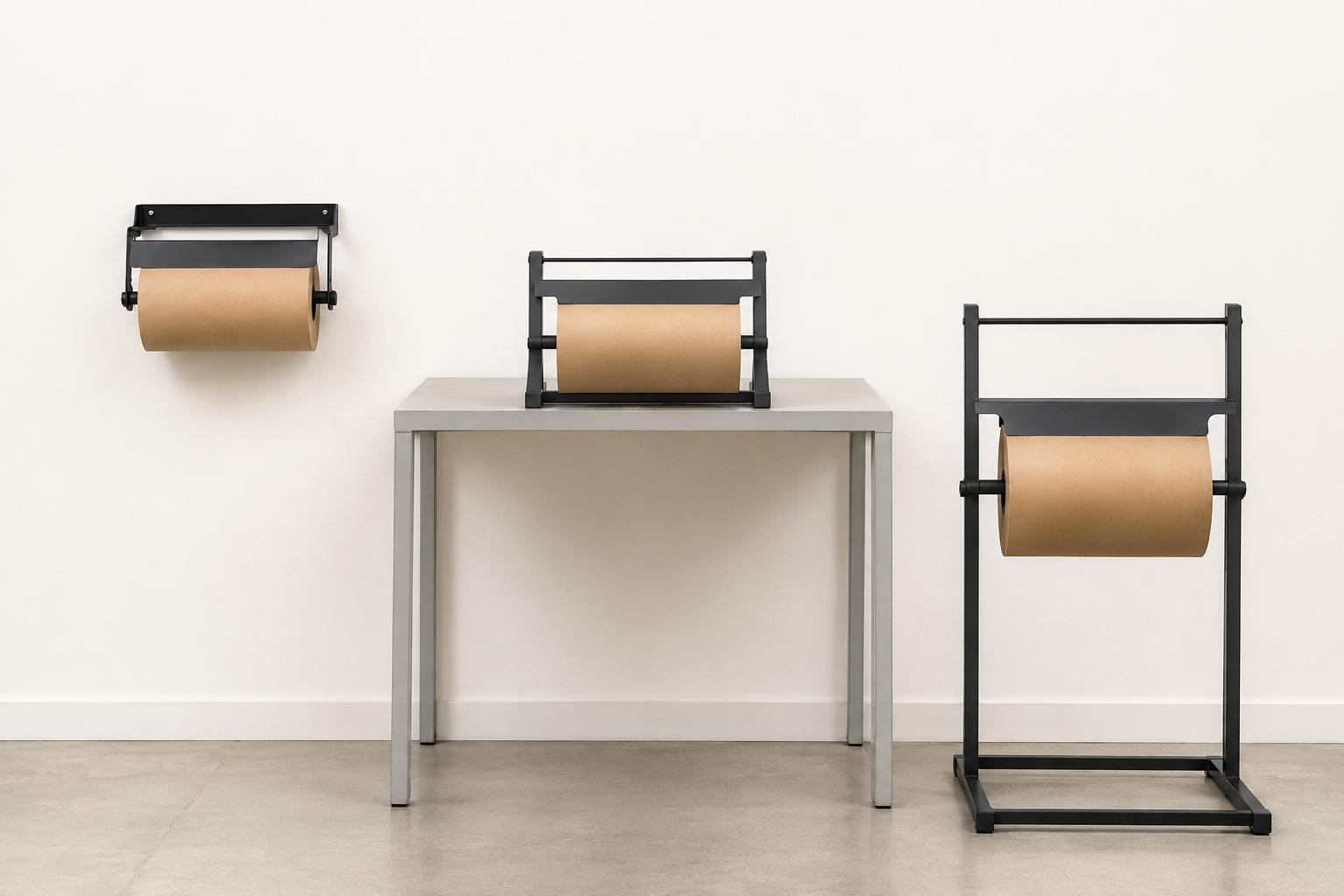
✓ Countertop units offer simple placement and flexibility but consume work surface. ✓ Wall-mounted units free the counter and suit stable, repeatable workflows. ✓ Freestanding units support larger rolls, more capacity and changing layouts. ✓ Loading height, reach, traffic and material travel matter as much as footprint. ✓ Use a quick site observation before deciding where equipment should live. |
|
START WITH THE AVAILABLE WORK ZONE |
Measure more than the equipment footprint. A dispenser needs room for the roll, the operator, the material being pulled and the finished piece. Observe drawers, doors, carts and coworkers that pass through the same space. A compact unit can still create congestion if material must cross an aisle.
Mark the proposed location temporarily and simulate a normal cut. This simple exercise exposes reach problems and blocked surfaces before holes are drilled or floor space is committed.
|
COUNTERTOP: ACCESSIBLE AND ADAPTABLE |
Countertop dispensers are easy to place near the task and generally require little installation. They fit low-to-moderate volume stations, changing layouts and situations where the equipment may need to be removed for cleaning or seasonal work.
The cost is usable surface area. Confirm that the base remains stable during the cutting motion and that the roll does not interfere with scales, prep areas or assembly work.
|
WALL-MOUNTED: CLEAR THE WORK SURFACE |
Wall-mounted equipment is valuable when a station has a fixed purpose and countertop space is scarce. The material stays in a consistent location, which can simplify training and keep the work surface available for measuring, wrapping or food preparation.
Installation quality is critical. Verify the wall construction, hardware, clearance and allowable load. Set the height for comfortable pulling and loading—not merely where the unit fits visually.
|
FREESTANDING: CAPACITY AND FLEXIBILITY |
Freestanding racks can support heavier, wider or multiple rolls without depending on a wall or counter. They work well in art rooms, packaging departments, shared material areas and retail operations that need a dedicated station.
They require deliberate floor planning. Include the space needed to load rolls and, for mobile models, lock casters and turn the unit. A mobile rack should have a defined storage position so it does not become an aisle obstruction.
|
Factor |
Countertop |
Wall-mounted |
Freestanding |
|
Best advantage |
Simple and flexible |
Preserves work surface |
Capacity and placement |
|
Typical capacity |
Light to moderate |
Moderate; model dependent |
Moderate to high |
|
Installation |
Minimal |
Secure mounting required |
Floor space required |
|
Relocation |
Easy |
Limited |
Possible; mobile options |
|
Main risk |
Surface congestion |
Poor mounting or reach |
Traffic obstruction |
|
USE A PLACEMENT SCORECARD |
Score each option against the actual operation rather than choosing by appearance. Give greater weight to the factors that affect every work cycle: reach, material path, loading and available work surface. Installation cost matters, but a poor location creates recurring labor and safety costs.
|
Question |
Yes points to |
|
Must the counter remain open? |
Wall-mounted or freestanding |
|
Will the station move or change? |
Countertop or mobile freestanding |
|
Are rolls heavy or numerous? |
Freestanding |
|
Is the process fixed and repetitive? |
Wall-mounted |
|
Is cleaning access essential? |
Removable countertop or mobile unit |
|
💡 QUICK TIP Keep one sample roll or a verified specification sheet beside the equipment-selection record so future substitutions can be checked quickly. |
|
CHECK ERGONOMICS AND SAFETY BEFORE APPROVAL |
The operator should be able to pull material in a straight path with shoulders relaxed and feet stable. Avoid locations that require reaching across hot equipment, sharp edges or active aisles. Loading should not require awkward lifting above shoulder height.
For shared stations, test with users of different heights and dominant hands. Document the mounting location and inspection routine, especially where fasteners or casters affect stability.
|
SELECT FOR THE NEXT NORMAL YEAR |
Allow for realistic growth in roll use and material variety, but do not design around an unlikely maximum. A clear understanding of typical volume, peak periods and planned layout changes will produce a setup that remains useful without wasting valuable space.
If several stations use the same material, compare one higher-capacity shared location with smaller point-of-use dispensers. A shared rack can simplify inventory, while point-of-use equipment can reduce walking and waiting. The better choice depends on replenishment frequency, travel distance and whether employees compete for access during peak work.
Before standardizing, run a short trial and ask operators about reach, stability, loading and cleanup. Small placement changes are inexpensive during a pilot and disruptive after multiple units are installed.
|
⚠ COMMON MISTAKE Selecting the smallest footprint → operating clearance and material travel are ignored → measure the full work zone and simulate loading, pulling and cutting before installation. |
|
CONCLUSION |
A roll dispenser or cutter earns its place by making routine work more controlled, repeatable and practical. A disciplined selection process reduces fit surprises, protects workspace and gives operators equipment that works with the material rather than against it.
|
✓ KEY TAKEAWAY Countertop favors adaptability, wall-mounted favors clear surfaces and repeatability, and freestanding favors capacity. The best setup is the one that makes the entire work cycle fit. |
Explore Equipment
Share:
How to Choose Equipment Based on Roll Width, Diameter and Weight
Straight-Edge vs. Serrated Cutters: Which Is Right for Your Material?