
|
THE 30-SECOND VERSION · Require high-visibility apparel where people work near public traffic or moving equipment and visibility is a meaningful risk factor. · Use designated zones and task rules so employees know exactly when apparel is required. · Night, weather, glare, blind corners and visual clutter can raise the needed level of visibility. · Apparel complements separation, traffic control and training; it does not replace them. |
|
USE EXPOSURE AS THE TRIGGER |
“Outside” or “in the warehouse” is too broad to be a useful rule. The practical trigger is exposure: can a vehicle or equipment operator fail to detect a person early enough to avoid a collision? If yes, high-visibility apparel may be necessary as part of the control plan. The assessment should consider both routine work and short tasks such as opening a trailer door, crossing a yard or retrieving material near a travel lane.
Some environments have explicit requirements. Highway and temporary traffic control work can fall under federal or state rules and project specifications. OSHA has also treated high-visibility warning garments as necessary protection for certain highway construction exposures. For other workplaces, the employer’s PPE and traffic-control assessments determine the policy.
|
COMMON SITUATIONS THAT WARRANT EVALUATION |
|
Work situation |
Why visibility matters |
Typical policy trigger |
|
Roadway or shoulder work |
Workers are exposed to public traffic and changing approach speeds. |
Before entering the right-of-way or temporary traffic control area. |
|
Warehouse travel aisles |
Forklifts and pedestrians share space; loads can block sight lines. |
When leaving protected pedestrian paths or entering designated equipment zones. |
|
Loading docks and yards |
Trucks back, turn and couple around noise, blind spots and changing light. |
Any time a worker is on the dock apron, yard or trailer approach area. |
|
Construction sites |
Mobile equipment, deliveries and uneven routes create unpredictable movement. |
Within the site’s defined equipment interaction zone. |
|
Parking and delivery areas |
Drivers may not expect employees on foot. |
During cart retrieval, traffic direction, deliveries or outdoor maintenance. |
|
Low-light or poor weather work |
Distance, contrast and reaction time are reduced. |
During night work, dawn/dusk, fog, rain or inadequate illumination. |
|
ROADWAY AND TRAFFIC-CONTROL WORK |
Workers in or near roadway traffic need particular attention because approach speeds can be high and the environment changes continuously. The current MUTCD should be consulted for worker apparel requirements in temporary traffic control zones, and state agencies may adopt or supplement it on their own schedules. Flaggers, inspectors, delivery personnel and supervisors can be exposed even when they are not performing construction labor.
|
⚠ COMMON MISTAKE Problem: requiring a vest only for the “road crew.” ↓ Why it happens: support roles are viewed as visitors. ↓ Better approach: base the rule on where the person goes and what traffic or equipment they face, not their job title. |
|
WAREHOUSES, DOCKS AND INDUSTRIAL YARDS |
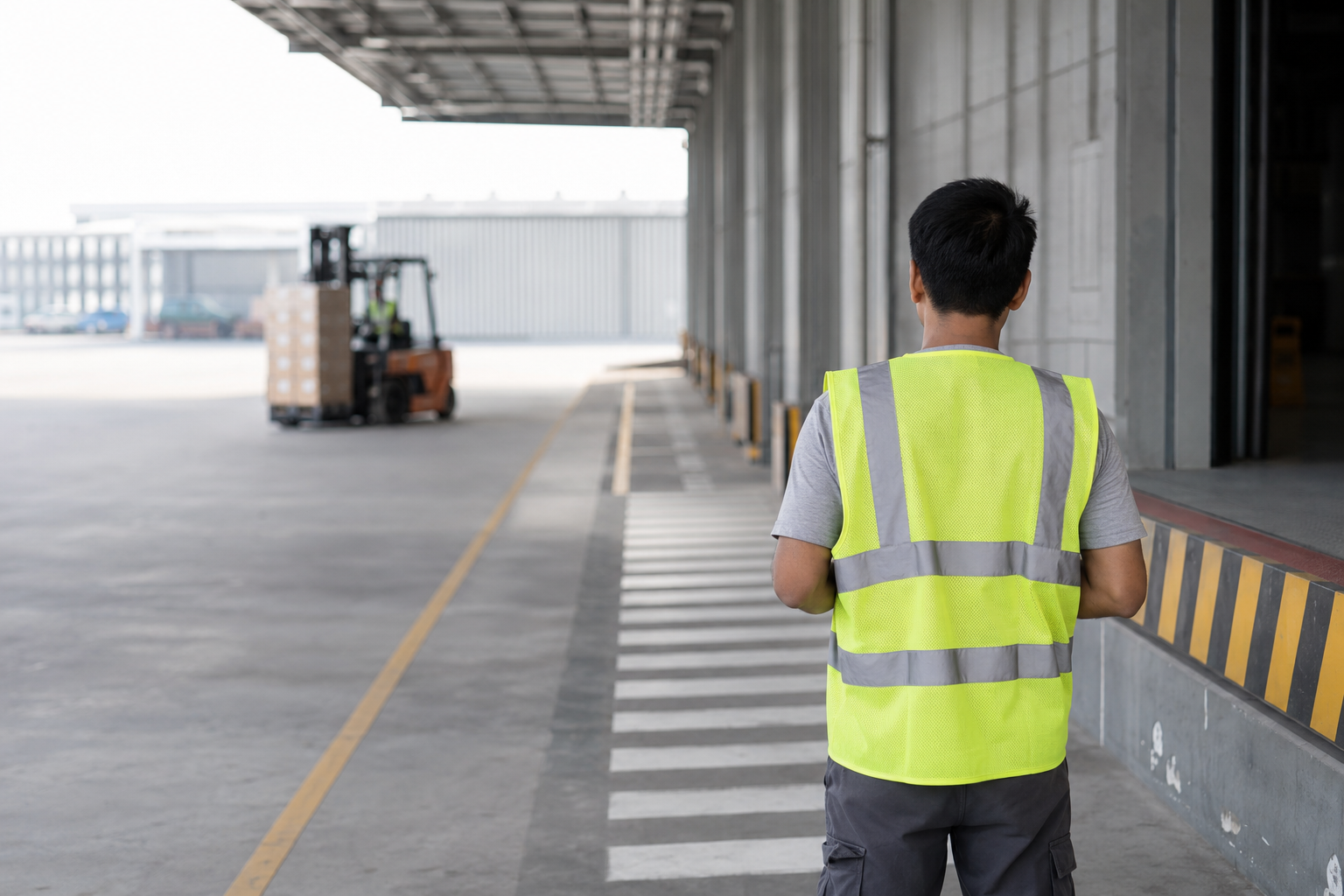
A warehouse does not automatically require high-visibility apparel everywhere, but shared forklift and pedestrian space deserves a structured assessment. Use physical separation first: marked walkways, guardrails, controlled crossings, mirrors, lighting and travel rules. Apparel becomes especially useful where separation is incomplete, sight lines are poor, or workers must enter active equipment areas.
Loading docks and yards often deserve stricter rules than interior spaces. Workers may step between trailers, cross backing paths or move from bright daylight into a dark building. A clear zone-based policy—supported by signs, garment stations and supervisor enforcement—is easier to follow than asking employees to make a fresh judgment each time.
|
CONDITIONS THAT RAISE VISIBILITY RISK |
· Night, dawn, dusk, shadows or sudden transitions between indoor and outdoor light.
· Rain, snow, fog, dust or steam that reduces contrast and viewing distance.
· Complex backgrounds such as equipment, racks, vegetation or construction materials.
· Blind corners, backing movements, elevated noise and restricted operator views.
· Tasks that place workers low to the ground, behind loads or outside expected pedestrian routes.
· Outerwear, tools or carried objects that cover fluorescent or reflective material.
|
ⓘ DID YOU KNOW? A worker can be brightly dressed yet still difficult to identify as a person. Garment design and reflective placement help create recognizable human shape and movement, especially when lighting is limited. |
|
TURN THE ASSESSMENT INTO A CLEAR POLICY |
|
Policy element |
Good practice |
|
Where |
Map required zones: roadway areas, equipment aisles, yards, docks and outdoor maintenance routes. |
|
When |
Define shifts, weather conditions and temporary tasks that activate the requirement. |
|
What |
Name the approved garment type, performance class, color and any task-specific features. |
|
Who |
Include employees, supervisors, visitors, contractors and drivers when their exposure is equivalent. |
|
How |
Explain donning, closure, layering, inspection, cleaning and replacement expectations. |
|
SHIRT OR VEST? |
A vest is practical for intermittent exposure, visitors and employees who need to place visibility over changing layers. A high-visibility shirt can be better for all-shift use, warm conditions or work where an extra loose layer is undesirable. The format does not override the required performance: verify the label, type and class, and make sure the complete worn configuration stays visible.
|
💡 QUICK TIP Place spare garments at the boundary of required zones rather than in a distant supply room. The physical workflow should make the safe choice the easy choice. |
|
INSPECTION AND SUPERVISION |
Supervisors should check more than whether a worker owns a vest. The garment must be worn on the outside, closed as designed, properly fitted and free from severe fading, damage or contamination. Replacement criteria and approved spares should be written into the program so employees are not forced to choose between delaying work and using ineffective apparel.
Observe actual work periodically. Near misses, new equipment, layout changes, seasonal darkness and altered delivery routes can all change exposure. Revisit the hazard assessment whenever the work pattern changes, not only after an incident.
|
✓ KEY TAKEAWAY Workers should wear high-visibility apparel whenever early visual detection is an important part of controlling exposure to traffic or mobile equipment—and whenever a regulation, project rule or site policy requires it. Define the rule by zone and task so there is no guesswork. |
|
CONCLUSION |
The right question is not “Does everyone need a vest?” It is “Where could a person be missed by someone operating a vehicle or machine?” Answering that question produces a focused policy that covers roadway crews, warehouse pedestrians, dock personnel and occasional visitors without turning high-visibility apparel into a substitute for stronger controls.
Explore Shirts and Vests
Share:
Common Toilet Paper and Dispenser Compatibility Problems
Safety Shirts vs. Safety Vests